
Cropping Patterns – Agriculture
India is known for its rich agricultural diversity. This is because of its varied climates, soils, and rainfall. Farmers in India use different cropping patterns to match the climate and soil of their regions. A cropping pattern is the proportion of area under different crops at any given time.
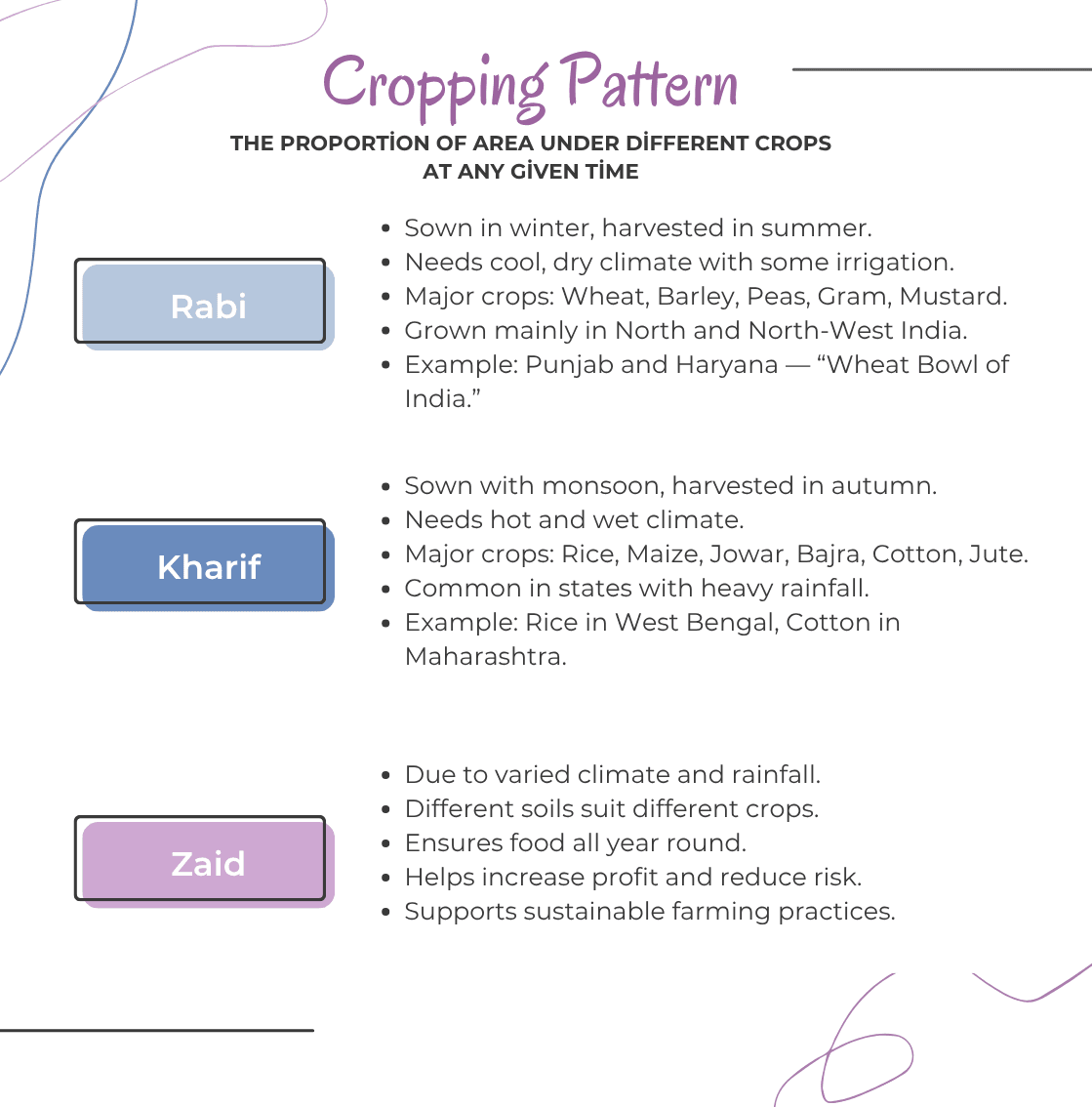
1. Rabi Season
Description:
- Rabi crops are sown in winter (October–December) and harvested in summer (April–June).
- They need cool and dry weather to grow. Sometimes, moderate irrigation is needed.
Regions:
- North and north-western India (mainly Punjab, Haryana, Uttar Pradesh, Rajasthan, Madhya Pradesh).
Main Crops:
- Wheat, barley, peas, gram (chana), mustard, linseed.
Detailed Explanation:
- Wheat is the major Rabi crop and India is one of the largest producers.
- Barley is another Rabi crop, grown widely in Rajasthan.
- Gram (Chana), Mustard, and Peas are also important Rabi crops.
Examples:
- Punjab and Haryana are called the "Wheat Bowl of India" because they produce a lot of wheat in the Rabi season.
- Barley is grown mostly in Rajasthan and used for making malt.
2. Kharif Season
Description:
- Kharif crops are sown at the start of the monsoon (June–July) and harvested at the end (September–October).
- They require a hot and wet climate, with high temperature and heavy rainfall.
Regions:
- Areas with good rainfall: Karnataka, Kerala, West Bengal, Assam, Maharashtra, Andhra Pradesh, Odisha, eastern Uttar Pradesh, Chhattisgarh, Bihar.
Main Crops:
- Rice, maize, jowar (sorghum), bajra (pearl millet), arhar (pigeon pea), cotton, jute, groundnut, soybean, turmeric, sugarcane.
Detailed Explanation:
- Rice is the main Kharif crop in eastern and southern states.
- Jute is grown for making ropes and bags, mostly in West Bengal and Assam.
- Cotton is important for the textile industry and is grown mainly in Maharashtra and Gujarat.
Examples:
- West Bengal is famous for its Kharif rice production.
- Jute (the "golden fiber") is a Kharif crop grown in West Bengal.
- Cotton fields in Maharashtra and Gujarat come alive during the Kharif season.
3. Zaid Season
Description:
- Zaid crops are cultivated in the short season between Rabi and Kharif (March to June).
- The season is marked by warm, dry weather and longer days. Irrigation is usually essential.
Regions:
- Northern India is most active in zaid cropping. Also parts of Punjab and Haryana.
Main Crops:
- Watermelon, muskmelon, cucumber, various vegetables (bitter gourd, bottle gourd, pumpkin), fodder crops, early sown sugarcane, moong, and urid.
Detailed Explanation:
- Farmers grow quick-maturing fruits and vegetables to make use of the short window between major seasons.
- Zaid crops supply fresh vegetables and fruits during summers.
Examples:
- Watermelon, muskmelon, and cucumber in North India are popular zaid crops.
- Vegetable growers in Punjab supply fresh cucumbers and gourds during summer.
Why do we have Different Cropping Patterns?
- Varying climate: India has regions that are hot, cold, dry, or wet. Different crops suit different climates.
- Soil differences: Black soil, alluvial soil, and red soil are good for different crops.
- Rainfall: Varied rainfall across India means some crops need irrigation while others use rainwater.
- Food security: Growing different crops ensures food is available throughout the year.
- Profit and sustainability: Diverse crops mean farmers can earn more and protect themselves from crop failure.
Examples:
- In Rajasthan, farmers choose barley and mustard in Rabi because they survive in dry conditions.
- In Tamil Nadu, frequent rainfall means farmers plant more rice.
- In Punjab, both Rabi wheat and Zaid vegetables are grown to maximize profit.
Summary Table
| Season | Sowing Time | Harvest Time | Main Crops | States/Regions |
|---|---|---|---|---|
| Rabi | Oct–Dec | Apr–Jun | Wheat, Barley, Peas, Gram, Mustard | Punjab, Haryana, UP, Rajasthan |
| Kharif | Jun–Jul | Sep–Oct | Rice, Maize, Jowar, Bajra, Cotton, Jute, Groundnut, Soybean | West Bengal, Assam, Maharashtra, AP, Odisha, Punjab |
| Zaid | Mar–Jun | Apr–Jun | Watermelon, Muskmelon, Cucumber, Veggies, Fodder | North India, Punjab, Haryana |
Fun Activity – Identification of Crops by Season
Objective: Identify which crops belong to Rabi, Kharif, or Zaid by using flashcards with crop pictures.
Steps:
- Create or collect small cards with pictures and names of different crops.
- Spread them out on a table.
- Students pick a card, say the crop name, and place it in the tray labeled Rabi, Kharif, or Zaid.
Observation:
- Wheat should go in the Rabi tray.
- Rice should go in Kharif.
- Watermelon should be in Zaid.
Elaboration:
This activity helps students visually remember which crops are grown in which season. It also makes studying crop patterns fun and interactive!
Scenario Based Questions
-
Scenario: You are a farmer in Punjab with excellent irrigation facilities.
- Question: Which cropping pattern will help you maximize your annual income?
- Answer: You can grow Rabi crops like wheat during winter, and Zaid crops like cucumbers or gourds in early summer. This double-cropping ensures a steady income.
-
Scenario: A drought is expected in Maharashtra this year.
- Question: Which crops would be less risky to plant during Kharif?
- Answer: Bajra and jowar are more drought-resistant than rice. These are safer choices during low rainfall years.
-
Scenario: Your school wants to organize a summer vegetable fair in North India.
- Question: Which crops should students exhibit as summer produce?
- Answer: Watermelon, muskmelon, cucumber, and pumpkin are ideal zaid crops for the fair.
-
Scenario: Your friend is confused about why rice is mainly grown as a Kharif crop in Tamil Nadu.
- Question: How would you explain this to them?
- Answer: Rice needs lots of water, which is available during the Kharif season due to heavy monsoon rains in Tamil Nadu.
-
Scenario: You visit a market in April and see fresh peas being sold.
- Question: Which season were these peas likely grown in?
- Answer: The peas were grown as a Rabi crop and harvested in April.
Tip: Remember Rabi = winter crop, Kharif = monsoon crop, Zaid = summer interim crop.