
Major Crops in India - Agriculture
India’s agriculture is the backbone of its economy. It provides not only food for millions but also raw material for industries and employment to a large number of people. Major crops in India are categorized into: Food Crops, Cash Crops (Commercial Crops), Horticultural Crops, and Non-food Crops.
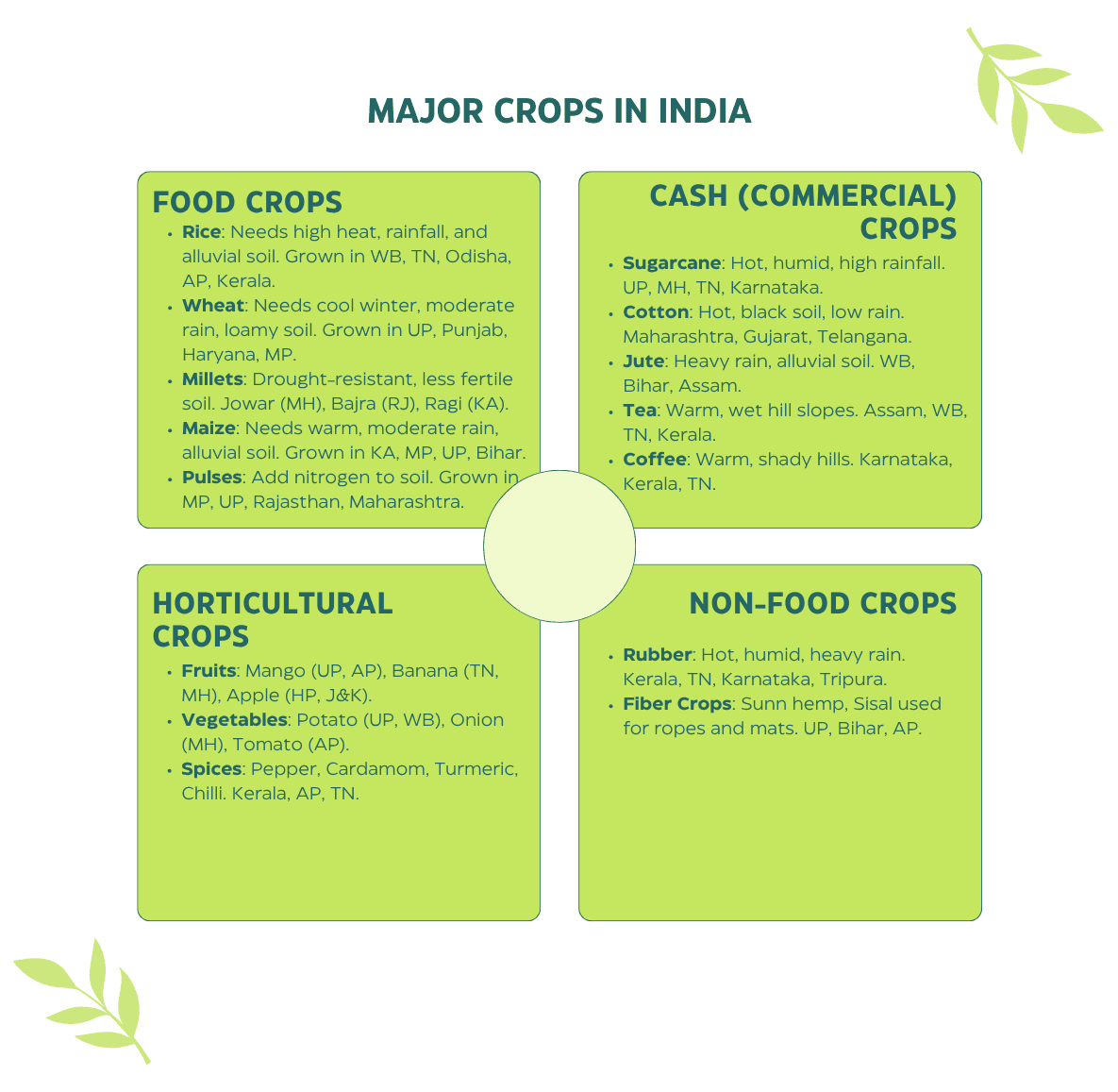
1. Food Crops
Definition: Food crops are crops grown mainly for human consumption as staple food.
a. Rice
- Significance: Rice is India’s most important staple food, especially for people in the eastern and southern parts.
- Climatic Requirements: Needs high temperature (above 25°C), high humidity, and plenty of rainfall (above 100 cm). Grows best in alluvial soil.
- Major Areas: West Bengal, Uttar Pradesh, Punjab, Tamil Nadu, Andhra Pradesh, Odisha, Assam, Kerala, Chhattisgarh.
- Important Varieties: Basmati (Punjab, Haryana), Sona Masuri (Andhra Pradesh).
Examples:
- Basmati rice from Punjab and Haryana is famous worldwide for its aroma.
- Sona Masuri rice is a staple in Andhra Pradesh and Telangana.
- Kerala’s ‘Matta’ rice is common in southern diets.
Important Points:
- Sown in Kharif season.
- Needs standing water at some stages.
b. Wheat
- Significance: Wheat is the second most important food crop after rice. It’s a staple in northern and north-western India.
- Climatic Requirements: Cool growing season, bright sunshine, moderate rainfall (50–75 cm), well-drained loamy and clayey soils.
- Major Areas: Uttar Pradesh, Punjab, Haryana, Madhya Pradesh, Rajasthan, Bihar.
- Major Varieties: Sharbati (Madhya Pradesh), Lokwan (Maharashtra).
Examples:
- Rotis made from wheat are common meals in north India.
- Madhya Pradesh’s Sharbati wheat is known for its sweetness.
- Lokwan wheat in Maharashtra is used widely for chapati flour.
Important Points:
- Grown in the Rabi season.
- Mechanized farming common in Punjab.
c. Millets
- Significance: Known as ‘coarse grains’ but are highly nutritious and drought-resistant.
- Types:
- Jowar (sorghum)
- Bajra (pearl millet)
- Ragi (finger millet)
- Major Areas:
- Jowar: Maharashtra, Karnataka, Andhra Pradesh, Madhya Pradesh.
- Bajra: Rajasthan, Maharashtra, Gujarat, Uttar Pradesh, Haryana.
- Ragi: Karnataka, Tamil Nadu, Uttarakhand, Sikkim, Jharkhand.
Examples:
- Bajra rotis are common in Rajasthan during dry seasons.
- Ragi mudde is a staple in Karnataka.
- Jowar bhakri (flatbread) is popular in Maharashtra.
Important Points:
- Can grow in less fertile soils.
- Require less water than rice and wheat.
d. Maize
- Significance: Used as food, fodder, and industrial raw material. Rich in carbohydrates.
- Climatic Requirements: Needs temperatures between 21–27°C, moderate rainfall, and well-drained alluvial soil.
- Major Areas: Karnataka, Madhya Pradesh, Uttar Pradesh, Bihar, Andhra Pradesh, Telangana.
Examples:
- Popcorn is made from maize.
- Cornflakes, a breakfast cereal, use maize.
- Maize flour is used for making ‘makke ki roti’ in Punjab.
Important Points:
- Sown in both Kharif and Rabi seasons.
- Hybrid varieties are giving high yields.
e. Pulses
- Significance: Main protein source for vegetarians. Improves soil fertility by nitrogen fixation.
- Examples:
- Gram (Chana)—Madhya Pradesh, Uttar Pradesh, Rajasthan, Maharashtra.
- Arhar/Tur (Pigeon pea)—Maharashtra, Karnataka, Madhya Pradesh, UP.
- Moong, Urad, Masoor (Lentil), Peas.
Examples:
- Dal-chawal (pulses with rice) is a staple meal across India.
- Udad dal is used for making Idli and Dosa batter in the south.
- Besan made from gram is used in snacks like pakoras.
Important Points:
- India is the largest producer and consumer of pulses.
- Pulses are usually grown in rotation with other crops.
2. Cash Crops (Commercial Crops)
Definition: Grown mainly for sale in the market and not for direct consumption by the cultivator.
a. Sugarcane
- Significance: Used to make sugar, jaggery (gur), and khandsari.
- Climatic Requirements: Hot and humid climate (21–27°C), rainfall (75–100 cm), fertile alluvial or black soil.
- Major Areas: Uttar Pradesh, Maharashtra, Karnataka, Tamil Nadu, Andhra Pradesh, Bihar, Gujarat.
Examples:
- Sugar mills in Uttar Pradesh process sugarcane.
- Gur made from sugarcane juice is used for sweets.
- Chewing sugarcane stalks is a common rural practice.
Important Points:
- Labour-intensive crop.
- Often grown near sugar mills to ensure fresh supply.
b. Cotton
- Significance: Main fibre crop and key raw material for textile industry.
- Climatic Requirements: High temperature (21–30°C), light rainfall (50–90 cm), requires black soil (regur).
- Major Areas: Maharashtra, Gujarat, Telangana, Andhra Pradesh, Madhya Pradesh, Punjab, Haryana, Rajasthan.
Examples:
- Cotton sarees from Gujarat are popular nationwide.
- Textile mills in Mumbai depend on cotton from Maharashtra.
- Bedsheets and towels use cotton fibre.
Important Points:
- Sown in Kharif season.
- Requires 6-8 months to mature.
c. Jute
- Significance: Called the ‘Golden Fibre’. Used to make gunny bags, carpets, ropes, and mats.
- Climatic Requirements: High temperature, heavy rainfall (more than 100 cm), alluvial soil.
- Major Areas: West Bengal, Bihar, Assam, Odisha, Meghalaya.
Examples:
- Jute bags are eco-friendly alternatives to plastic.
- Rugs and carpets from Assam use jute yarn.
- Packaging industries use jute sacks.
Important Points:
- Mainly grown in the Ganga and Brahmaputra delta.
- Jute industry provides employment to lakhs.
d. Tea
- Significance: India is a leading producer and exporter of tea. Major beverage crop.
- Climatic Requirements: Warm, humid climate with well-distributed rainfall, loamy soils on hill slopes.
- Major Areas: Assam, West Bengal (Darjeeling, Jalpaiguri), Tamil Nadu, Kerala, Tripura.
Examples:
- Assam tea is famous for its strong flavour.
- Darjeeling tea is renowned worldwide for its aroma.
- Nilgiri tea from Tamil Nadu is popular across south India.
Important Points:
- Tea estates employ many women as leaf-pluckers.
- Tea is exported to Europe, Russia, and the USA.
e. Coffee
- Significance: Plantation crop. India produces high-quality Arabica coffee.
- Climatic Requirements: Warm, wet, and shady environments; laterite soils on hill slopes.
- Major Areas: Karnataka, Kerala, Tamil Nadu.
Examples:
- Coorg in Karnataka is called India’s coffee cup.
- Filter coffee is a staple in south Indian homes.
- Coffee exports earn foreign exchange.
Important Points:
- Karnataka accounts for over 70% of India’s coffee.
- Most coffee is grown on small family-owned plantations.
3. Horticultural Crops
Definition: These include fruits, vegetables, spices, and flowers.
a. Fruits
- Major Crops: Mango, Orange, Banana, Apple, Grapes, Pineapple.
- Major Areas: Mango—Uttar Pradesh, Andhra Pradesh, West Bengal; Orange—Nagpur, Chhattisgarh; Banana—Tamil Nadu, Maharashtra; Apple—Jammu & Kashmir, Himachal Pradesh.
Examples:
- Alphonso mangoes from Maharashtra are exported worldwide.
- Apples from Himachal Pradesh reach markets across India.
- Bananas are eaten for breakfast in Kerala and Tamil Nadu.
Important Points:
- India is 2nd largest producer of fruits.
- Fruits are grown in both tropical and temperate regions.
b. Vegetables
- Major Crops: Potato, Onion, Tomato, Brinjal, Cauliflower, Cabbage.
- Major Areas: Potato—Uttar Pradesh, West Bengal, Bihar; Onion—Maharashtra, Karnataka; Tomato—Andhra Pradesh, Karnataka.
Examples:
- Bangaluru is known for fresh beans and tomatoes.
- West Bengal supplies vegetables to nearby regions.
- Potatoes from UP are used for chips and fries.
Important Points:
- Perishable, so grown near urban markets.
- Multi-cropping is common with vegetables.
c. Spices
- Major Crops: Black pepper, Cardamom, Turmeric, Chilli, Ginger, Clove, Nutmeg, Cumin.
- Major Areas: Kerala (pepper, cardamom, ginger), Andhra Pradesh, Tamil Nadu, Meghalaya.
Examples:
- Kerala black pepper is called ‘black gold’.
- Turmeric from Andhra Pradesh is used in curries.
- Cardamom is used in sweets and tea across India.
Important Points:
- India is called the ‘Land of Spices’.
- Many spices are exported.
4. Non-food Crops
Definition: Crops grown mainly for industrial and commercial uses, not for food.
a. Rubber
- Significance: Important industrial raw material for tyres, footwear, and other products.
- Climatic Requirements: Hot, humid climate; heavy rainfall (over 200 cm); well-drained laterite soils.
- Major Areas: Kerala, Tamil Nadu, Karnataka, Andaman & Nicobar Islands, Tripura.
Examples:
- Tyre companies source latex from Kerala.
- Rubber plantations are a major sight in Kottayam and Ernakulam.
- Tripura’s economy benefits from rubber exports.
Important Points:
- Kerala contributes nearly 90% of India’s rubber.
- Plantation crop, needs care for several years before yield.
b. Fibre Crops (Other than Cotton and Jute)
- Examples: Sunn hemp (used for making ropes), Sisal (used for mats and ropes).
- Major Areas: Sunn hemp is grown in Uttar Pradesh, Bihar, West Bengal; Sisal in Andhra Pradesh and Karnataka.
Examples:
- Sisal ropes are used for agricultural binding.
- Sunn hemp is used to make eco-friendly bags.
- Mats and ha...