
Types of Farming – Agriculture
Let’s make learning about Types of Farming interesting and easy to understand! We will look at the key points, explain them in detail, give clear examples, and add some fun scenario-based questions at the end.
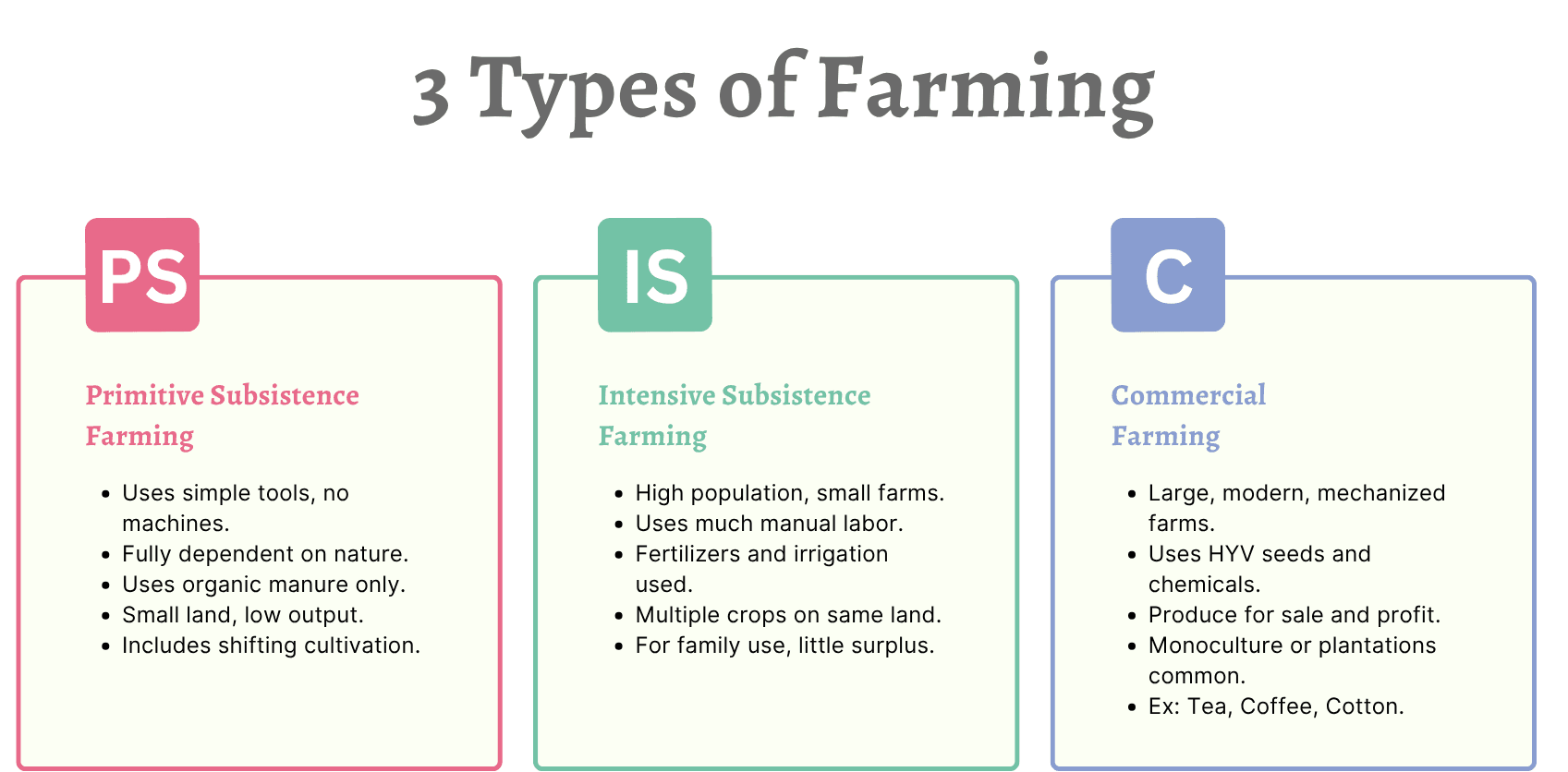
1. Primitive Subsistence Farming
Key Points:
a) Basic, Traditional Methods
Primitive Subsistence Farming is an old, basic way of growing food. Farmers use simple hand tools like digging sticks, hoes, and sickles. There are no machines.
- Important: Farmers depend on their own strength or family help.
- No machines are used at all.
- Land patches are small.
Examples:
- A family in Assam uses sticks and sickles to plant rice on a small plot.
- In Mizoram, groups clear patches with basic tools to grow maize.
- Farmers in Odisha use hoes to create their Podu fields.
b) Nature-Dependent Process
Farming depends totally on nature. It relies on natural rain, soil fertility, and sunlight. Nothing artificial is used.
- Important: If the rain is poor, crops can fail.
- Soil is not treated with chemicals; only natural fertility is used.
Examples:
- Jhumming in Nagaland fails if the monsoon is weak that year.
- In Dahiya farming in Madhya Pradesh, only naturally available water is used.
- Podu farmers move to another patch if soil loses fertility due to natural use.
c) No Use of Modern Inputs
Farmers do not use fertilizers, pesticides, or high-yield seeds. Only traditional seeds and organic manure are used.
- Important: The output is low, just enough for the family to survive.
- No chance of surplus.
Examples:
- A family in Meghalaya uses local rice seeds, not genetically improved ones.
- Farmers in Andhra Pradesh use cow dung as manure.
- In Sikkim, primitive farmers do not purchase chemical sprays.
d) Slash and Burn / Shifting Cultivation
In many regions, this method is called “Slash and Burn.” Farmers clear a patch, burn the vegetation, and cultivate crops there for 2-3 years. When soil loses nutrients, they shift to a new area.
- Important: This is called by many names:
- Jhumming (North-East)
- Bewar/Dahiya (Madhya Pradesh)
- Podu/Penda (Andhra Pradesh, Odisha)
- Kumari (Western Ghats)
- Also called "shifting cultivation."
Examples:
- Villagers in Meghalaya clear bamboo forest, burn it, and grow rice.
- In the Western Ghats, the Kumari system is used to grow millets for a few years.
- In Odisha, after farming for 3 years, the Podu land is abandoned and left to regenerate naturally.
Purpose:
Primitive farming is for self-consumption. Nothing is grown for selling in the market.
2. Intensive Subsistence Farming
Key Points:
a) High Population, Small Land
This method is used where a lot of people live, but there is not enough land for everyone. So, every small plot is cultivated intensively.
- Important: Land is scarce, but people are many.
- Every inch of land is used with great care.
Examples:
- Small rice fields in West Bengal are planted by several family members.
- In Kerala, tiny farms are made fertile by hard work.
- Wheat farms in Punjab are smaller but give high yields.
b) Much Manual Labor
This method uses a lot of human labor. The whole family, sometimes even children, work on the farm.
- Important: Machines are rare, people do most of the work by hand.
- When more people are available, more crops can be grown.
Examples:
- Rice planting in Tamil Nadu is done by hand by many people from a single family.
- Vegetable farming near cities like Kolkata is highly labor-intensive.
- Wheat weeding in Eastern Uttar Pradesh is done mostly by women and children.
c) Intensive Inputs and Multiple Cropping
Farmers use fertilizers, good seeds, manures, and irrigation to get more food from each field. They often grow 2-3 crops on the same field each year.
- Important: Aim is to produce as much as possible from small land.
- Multiple cropping means growing rice, then wheat, then a vegetable in the same year.
Examples:
- In Punjab, a field grows rice in summer and wheat in winter.
- In Uttar Pradesh, sugarcane and vegetables are grown on the same patch in one year.
- Kerala fields produce paddy, then vegetables, then banana.
Purpose:
Main purpose is to feed the family. If any extra crop is left after use, it is sold in the market nearby.
3. Commercial Farming
Key Points:
a) Large Farms and Modern Technology
These are huge farms, using tractors, harvesters, advanced irrigation, and chemical fertilizers.
- Important: Machines do most of the work. Large areas are cultivated at once.
- High yielding seeds and chemicals are used to get maximum crop.
Examples:
- A wheat farm in Haryana is ploughed and harvested by machines.
- Tea plantations in Assam use both machines and hired workers.
- Cotton fields in Maharashtra use chemical sprays for pests.
b) Purpose Is Sale, Not Family Use
The aim is to grow as much as possible for selling in the market. Almost nothing is kept for the farmers’ own use.
- Important: Main goal is profit and market supply.
- Often the produce goes to cities or is exported to other countries.
Examples:
- Tea from Assam plantations is shipped all over India.
- Coffee from Karnataka is exported to Europe.
- Sugarcane from Gujarat is sold to sugar factories.
c) Monoculture/Plantation Style
Usually, only one type of crop is grown on large areas (monoculture). Plantations are very common—huge farms with only one cash crop.
- Important: Examples of crops are Tea, Coffee, Rubber, Sugarcane, Banana, Cotton, and Jute.
Examples:
- A plantation in Kerala grows only rubber trees.
- Vast areas in Tamil Nadu are covered with coffee bushes.
- In Maharashtra, big fields produce only cotton.
Types of Commercial Farming:
- Plantation Agriculture: Large estates grow cash crops like tea and coffee, mainly for export.
- Commercial Grain Farming: Growing wheat and maize in places like Punjab and Haryana for the national and international market.
Purpose:
Produce is for sale, not for the farmer’s own use.
Summary Table
| Farming Type | Technique | Purpose | Scale | Examples |
|---|---|---|---|---|
| Primitive Subsistence | Basic, traditional | Self-use | Small | Jhumming (NE), Bewar (MP), Podu (AP) |
| Intensive Subsistence | Intensive, manual | Self/use/market | Small | Rice (WB), Wheat (Punjab), Vegetables |
| Commercial | Modern, mechanized | Market sale | Large | Tea (Assam), Cotton (Maharashtra), Wheat |
Some Fun Scenario-Based Questions!
1. Scenario: Ravi’s family clears a small patch of forest, burns it, and grows crops for two years. After the soil gets weak, they move to another area.
- Question: What type of farming is Ravi’s family practicing? Name any two regions in India where this is common.
- Answer: They are practicing ‘Primitive Subsistence Farming’ or shifting cultivation. This is called Jhumming in North-East India and Podu in Andhra Pradesh.
2. Scenario: You visit a small village in Kerala and notice families growing three crops per year on the same land using a lot of manual labor and fertilizers.
- Question: Which farming method is being followed? Why do they grow multiple crops on small land?
- Answer: They are following Intensive Subsistence Farming. They grow multiple crops because land is limited but there are many people to feed.
3. Scenario: A friend sees a huge, single-crop tea estate which is fully mechanized and sells all its tea to markets in India and abroad.
- Question: What type of farming is this? What is it called if only one cash crop is grown?
- Answer: This is Commercial Farming, specifically Plantation Agriculture or monoculture if only one crop is grown.
4. Scenario: A farmer in Punjab grows wheat using tractors, chemical fertilizers, and irrigation. After harvest, most of the food is sent to nearby cities.
- Question: Which farming type is being practiced here? Explain one advantage of this method.
- Answer: Commercial Farming. One advantage is higher productivity due to modern techniques.
5. Scenario: You read a news article about farming in hilly areas, where small village groups depend on forest lands and move every few years.
- Question: Which farming method does this describe? What problems can arise with this method?
- Answer: Primitive Subsistence Farming using shifting cultivation. Problems include soil erosion and deforestation.
Let’s make agriculture easy to remember:
- Small farms, hand tools, and shifting = Primitive
- Small farms, more effort, many crops = Intensive
- Big, modern, focused on selling = Commercial!