
Bonding in Carbon – The Covalent Bond
Understanding how carbon forms covalent bonds helps explain the diversity of organic molecules essential in daily life, industry, and especially agriculture. Let’s explore this topic step-by-step, focusing on key points, detailed explanations, and engaging examples.
1. What is a Covalent Bond?
- Definition: A covalent bond is a chemical bond formed when two atoms share one or more pairs of electrons.
- Key Feature: Atoms involved in covalent bonds attain a stable electronic configuration by sharing electrons, not transferring them as in ionic bonds.
- Significance: Covalent bonding is the basis for the huge variety of organic molecules found in living organisms, fuels, plastics, and more.
Important: Covalent bonds are usually formed between non-metallic elements.
Examples:
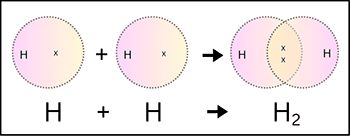
- The bond between two hydrogen atoms to form an H₂ molecule, where each shares one electron.
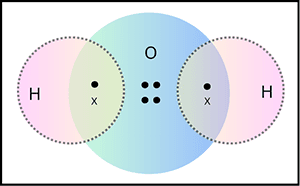
- A water molecule (H₂O), where oxygen shares electrons with two hydrogen atoms.
- The bond between two chlorine atoms in a Cl₂ molecule.
2. Carbon’s Electron Structure
- Atomic number of carbon: 6
- Electronic configuration: 2 electrons in the first shell, 4 in the second. (2, 4)
- Valency: Carbon requires 4 more electrons to achieve the stable octet (8 electrons in outermost shell).
Highlight: This makes carbon highly versatile, as it needs to form FOUR bonds to be stable.
Examples:
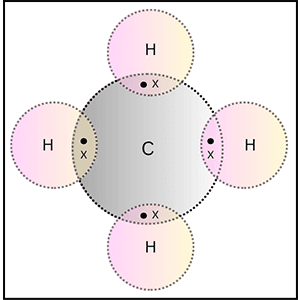
- In methane (CH₄), carbon forms bonds with four hydrogens.
- In carbon dioxide (CO₂), carbon forms double bonds with two oxygen atoms.
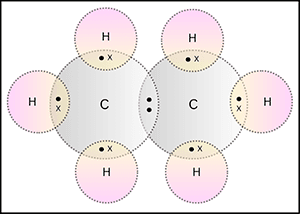
- In ethane (C₂H₆), carbon forms single bonds with another carbon and hydrogens.
3. Tetravalency of Carbon
- What is Tetravalency? Carbon’s ability to form four covalent bonds by sharing its four outer electrons with other atoms.
- Importance: This allows carbon to bond with many other elements and itself, leading to a vast range of compounds.
Highlight: Tetravalency is the reason why there are millions of organic compounds!
Examples:
- Methane (CH₄): One carbon atom shares electrons with four hydrogens.
- Urea (NH₂CONH₂): Carbon forms bonds with oxygen, nitrogen, and hydrogen.
- Glucose (C₆H₁₂O₆): Carbon forms bonds with other carbons, hydrogens, and oxygens to create a ring or chain structure.
4. How Does Carbon Form Covalent Bonds?
- By Sharing Electrons
- Carbon-Carbon Bond Variations
a. By Sharing Electrons
- Process: Carbon shares its four valence electrons with other atoms to form four covalent bonds, achieving a stable octet.
- Types of Bonds Formed:
- Single bonds: Sharing one pair of electrons.
- Double bonds: Sharing two pairs.
- Triple bonds: Sharing three pairs.
Examples:
- Methane (CH₄)
- Each hydrogen atom shares one electron with the carbon atom.
- Forms four single covalent bonds.
- Ethene (C₂H₄)
- Each carbon forms a double bond (two shared pairs) with the other carbon, and single bonds with hydrogens.
- Ethyne (C₂H₂)
- Two carbons share three electron pairs (triple bond) and each carbon bonds to one hydrogen.
b. Carbon–Carbon Bond Variations
Carbon can form multiple bonds with itself:
- Single bond (e.g., ethane, C₂H₆)
- Double bond (e.g., ethene, C₂H₄)
- Triple bond (e.g., ethyne, C₂H₂)
Examples:
- Ethane (C₂H₆): Two carbons joined by a single bond; each carbon bonds with three hydrogens.
- Ethene (C₂H₄): Two carbons joined by a double bond; each carbon bonds with two hydrogens.
- Ethyne (C₂H₂): Two carbons joined by a triple bond; each carbon bonds with one hydrogen.
Highlight: This property enables carbon to create chains, branches, and rings, resulting in millions of organic molecules.
5. Carbon Bonding with Other Elements
- With Oxygen: Carbon forms double covalent bonds with oxygen (e.g., CO₂).
- With Nitrogen: Forms compounds such as cyanides (CN⁻) or urea (NH₂CONH₂).
- With hydrogen, sulfur, phosphorus, and others: Forms diverse compounds essential for biological and industrial processes.
Examples:
- Carbon dioxide (CO₂): Each double bond consists of two pairs of shared electrons between carbon and oxygen.
- Urea (NH₂CONH₂): Important nitrogen fertilizer formed from carbon, nitrogen, hydrogen, and oxygen atoms.
- Cyanides (CN⁻): Used in mining and industry, with a triple bond between carbon and nitrogen.
6. Variety of Compounds Formed Due to Carbon’s Tetravalency
- Carbon forms stable chains (open/straight), branched, and ring structures.
- Can form single, double, triple bonds.
- Results in an immense variety of organic compounds.
Examples (related to agriculture and food):
- Glucose (C₆H₁₂O₆): Sugar produced in photosynthesis, key to plant energy.
- Proteins: Chains of amino acids (contain carbon-nitrogen bonds), essential for crop and animal growth.
- Fats & Oils: Oils like sunflower, mustard, etc., are carbon-rich compounds.
- Urea (NH₂CONH₂): Most-used nitrogen fertilizer globally.
- Cellulose: Structural compound in plants, formed by long chains of carbon atoms.
7. Importance in Agriculture
- Fertilizers: Urea, an organic carbon compound, is a major fertilizer ingredient.
- Pesticides: Most are organic - i.e., carbon-based chemicals.
- Biofuels: Methane (CH₄) produced from organic matter (biogas plants).
- Soil Fertility: Organic matter (humus) in soil improves soil quality and is rich in carbon compounds.
Examples:
- Methane is produced from decaying agricultural waste and used as a fuel.
- Ethene is used to artificially ripen fruits.
- Urea enhances crop growth by providing nitrogen.
8. Exam-Ready Summary Table: Covalent Bonding in Carbon
| Compound | Structure | Usage / Relevance |
|---|---|---|
| Methane (CH₄) | Tetrahedral, single bonds | Biogas, natural gas |
| Ethane (C₂H₆) | Single C–C bond | Fuel |
| Ethene (C₂H₄) | Double bond | Fruit ripening |
| Ethyne (C₂H₂) | Triple bond | Welding |
| Glucose (C₆H₁₂O₆) | Chains/rings | Plant energy, food |
| Urea (NH₂CONH₂) | Multiple bonds | Fertilizer |
| Carbon Dioxide | Two double bonds | Photosynthesis |
Scenario-Based Questions and Answers
-
Scenario: You’re in a science fair and need to explain why carbon-based compounds are crucial in agriculture.
- Question: How would you showcase the significance of carbon’s covalent bonding in agriculture?
- Answer: I’d the role of carbon compounds in fertilizers like urea, biofuels like methane from crop waste, and organic matter enriching soil fertility. Covalent bonding allows these diverse molecules to exist.highlight
-
Scenario: Your classroom is making a model of methane. A friend asks why there are four hydrogens around every carbon.
- Question: How will you explain this arrangement?
- Answer: Carbon forms four covalent bonds due to its tetravalency, meaning it can share electrons with four hydrogen atoms, making a stable methane molecule.
-
Scenario: While studying fruit ripening in agriculture, you hear about ethene gas.
- Question: What is special about ethene’s bonding?
- Answer: Ethene (C₂H₄) has a double bond between its two carbon atoms. This double bond makes it reactive, enabling it to trigger fruit ripening processes.
-
Scenario: A farmer wishes to switch to organic fertilizers and asks about the role of carbon in such compounds.
- Question: How will you describe it?
- Answer: Most organic fertilizers are rich in carbon compounds, such as urea and compost. The carbon forms stable bonds, allowing slow nutrient release and better soil structure.
-
Scenario: In a quiz, you’re asked why we rarely find carbon forming ionic bonds.
- Question: How would you answer?
- Answer: Carbon neither easily loses nor gains four electrons due to high energy requirements. Instead, it prefers sharing, making covalent bonding most suitable for its four valence electrons.
That’s your comprehensive guide—with key points, explanations, fun activities, and exam-focused insights—on Bonding in Carbon – The Covalent Bond!