
Chains, Branches, and Rings in Carbon Compounds
🔑 Key Point 1: Catenation — Carbon’s Unique Property
Explanation:
- Carbon can form strong covalent bonds with other carbon atoms.
- This property is called catenation.
- As a result, carbon atoms can join to form long chains, branched structures, and rings.
- This is why there are so many carbon compounds found on Earth.
Elaboration:
- Catenation allows carbon to create stable and versatile structures.
- It’s the reason for the existence of simple compounds (like methane) and very complex ones (like proteins and DNA).
- The four valence electrons in a carbon atom allow it to share electrons easily and create stable bonds.
Examples:
- Methane (CH₄): One carbon atom bonded to four hydrogen atoms.
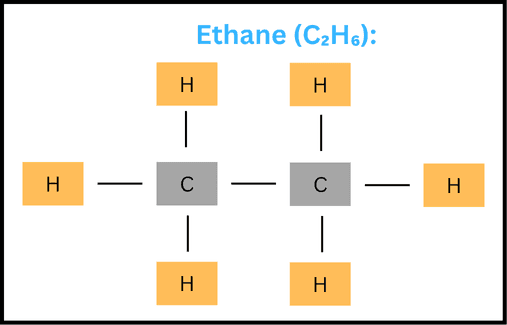
- Ethane (C₂H₆): Two carbons bonded together, each with enough hydrogens to complete four bonds.
- Glucose (C₆H₁₂O₆): A compound with a chain of six carbon atoms.
🔑 Key Point 2: Straight Chain (Open Chain) Compounds
Explanation:
- In these compounds, carbon atoms are bonded end-to-end in a line.
- The chain can be straight or slightly bent, but there are no branches.
Elaboration:
- All carbons except the ends are connected to at least two other carbons.
- Hydrogens fill up the remaining valencies of each carbon atom.
- These are the simplest forms of organic compounds.
Examples:
- Ethane (C₂H₆):
- Structure: H₃C–CH₃
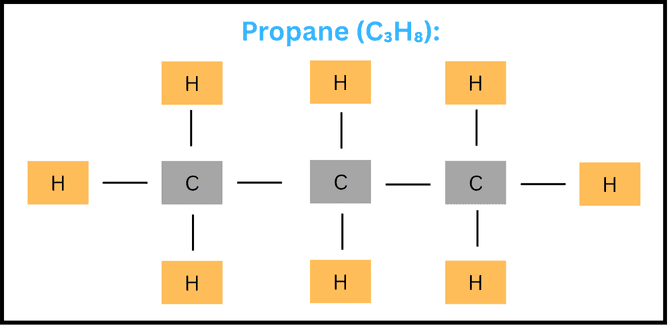
- Propane (C₃H₈): - Structure: H₃C–CH₂–CH₃
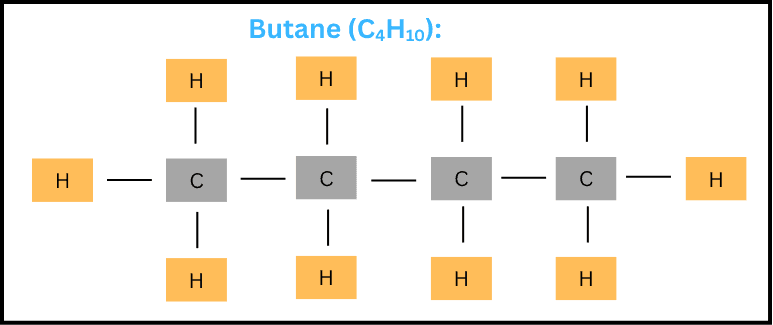
- Butane (C₄H₁₀):
- Structure: H₃C–CH₂–CH₂–CH₃
🔑 Key Point 3: Branched Chain Compounds
Explanation:
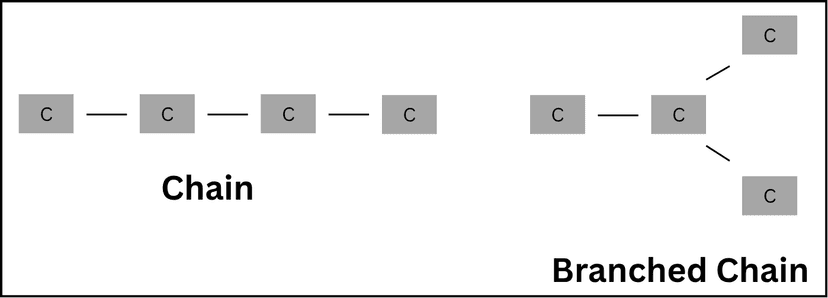
- Sometimes, a carbon atom or group of atoms branches off from the main chain.
- This creates a side group, called an alkyl group.
Elaboration:
- Branched chains look like a main "spine" with "arms" sticking out.
- The properties of branched and straight chain compounds with the same formula can be different!
- These are also called isomers if they share the same molecular formula but have a different arrangement.
Examples:
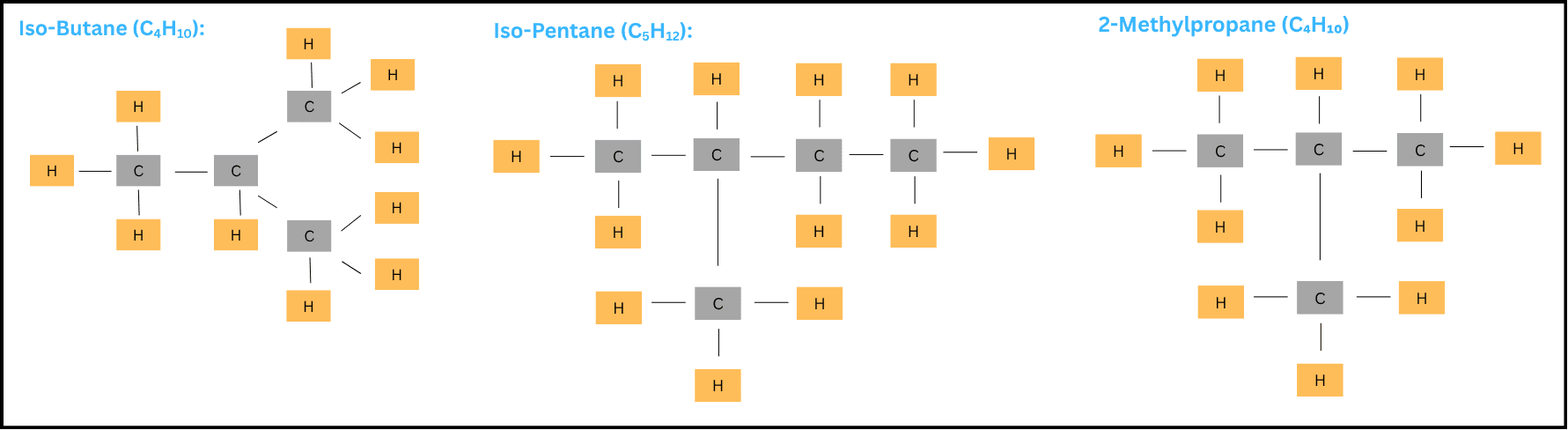
- Isobutane (C₄H₁₀):
- Structure: One central carbon with three methyl groups attached.
- Iso-pentane (C₅H₁₂):
- Structure: Four-carbons main chain with a methyl group on the second carbon.
- 2-Methylpropane (C₄H₁₀):
- Structure: Three carbons in a chain with a methyl branch on the middle carbon.
🔑 Key Point 4: Rings (Cyclic Compounds)
Explanation:
- Carbon atoms can also connect "end to end" to make closed loops or rings.
- Rings can have only carbon atoms (homocyclic) or include other atoms like nitrogen or oxygen (heterocyclic).
Elaboration:
- Many important molecules in nature (like glucose, benzene) are ring-shaped.
- Ring structures can have single or multiple bonds.
- Aromatic rings (like benzene) have special stability because of their bonding.
Examples:
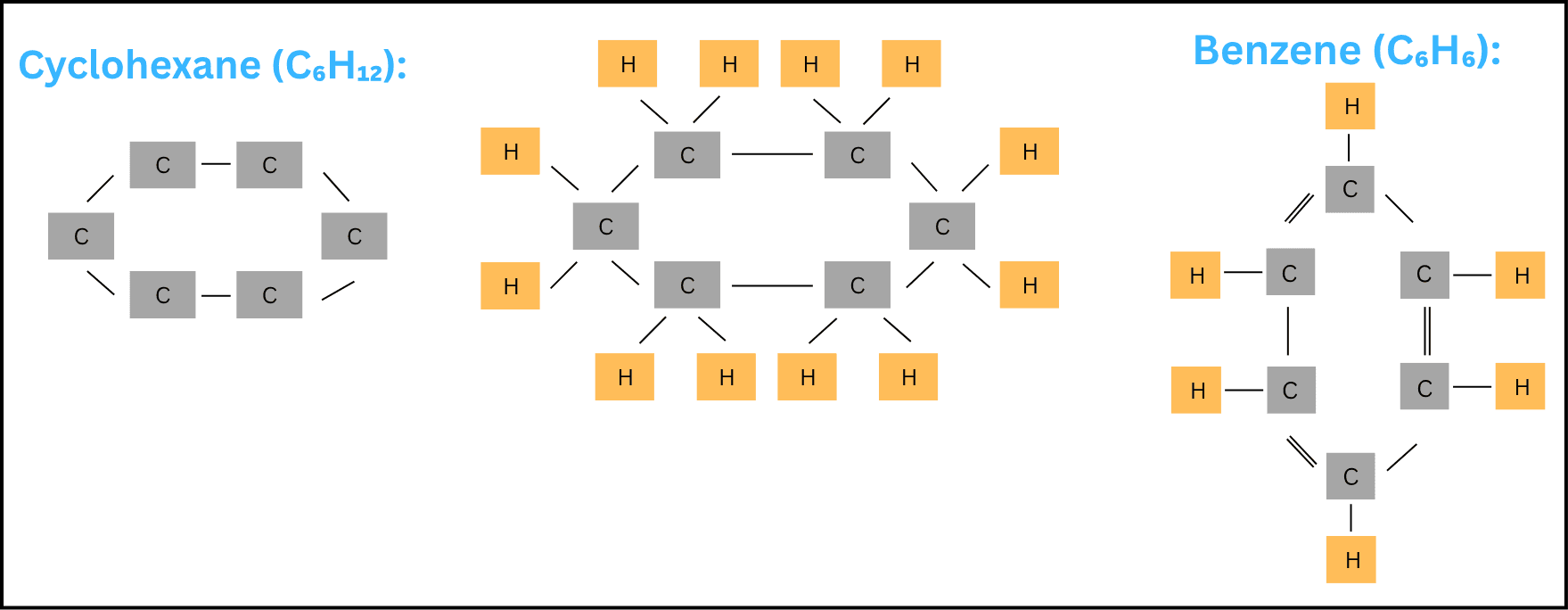
- Cyclohexane (C₆H₁₂):
- Structure: Six carbons in a ring, each bonded to two hydrogens.
- Benzene (C₆H₆):
- Structure: Six carbons in a hexagonal ring with alternating double bonds.
🔑 Key Point 5: Importance of Carbon’s Versatility
Explanation:
- Carbon can create a huge variety of compounds because it forms chains, branches, and rings.
- This versatility forms the basis of all organic chemistry and life processes.
Elaboration:
- The same set of carbon, hydrogen, and oxygen atoms can make thousands of different compounds just by changing how they’re connected.
- Carbon’s ability is central in the formation of biomolecules (like carbohydrates, proteins, nucleic acids).
- That is why life on Earth is called "carbon-based".
Examples:
- Cellulose and Starch: Both made of glucose units but arranged differently.
- Amino Acids: All have a carbon chain but different side groups.
- DNA and RNA: Ring structures of carbon, hydrogen, nitrogen, oxygen, and phosphorus make the genetic code.
💡 Fun Activity: Building Models of Organic Compounds!
Objective: To understand how carbon atoms can connect to form chains, branches, and rings.
Materials Needed:
- Toothpicks (represent bonds)
- Small clay balls or thermocol balls (black for carbon, white for hydrogen, red for oxygen, blue for nitrogen)
Activity Steps:
A. Making a Straight Chain
- Use black balls to represent carbon atoms.
- Connect two or more black balls in a line using toothpicks.
- Attach white balls (hydrogen) to each black ball until every carbon has four connections.
- You’ve built a straight chain compound like ethane or propane!
Observation: The model will be a single straight line. All carbons are connected only to two other carbons (except at the ends).
B. Making a Branched Chain
- Build a straight chain of three or four carbon atoms as before.
- Add another black ball (carbon) as a branch to the middle carbon.
- Attach hydrogen balls to all carbons so each has four bonds.
Observation: You’ll see a "main line" with a "branch" sticking out, like isobutane.
C. Making a Ring Structure
- Take four, five, or six black balls (carbons).
- Connect them end to end and then connect the last one back to the first to form a closed ring.
- Add hydrogen atoms as needed.
Observation: The carbons form a closed shape — a ring!
What do you learn?
- You will see directly how carbon forms chains, branches, and rings.
- You’ll realize how just linking balls in different ways makes many new structures — just like real molecules!
📝 Scenario-Based Questions
1. Scenario: You observe that two bottles labeled C₄H₁₀ look and smell different.
- Question: What could explain this, if the formula is the same?
- Answer: The bottles contain different isomers — same formula, different structures (straight chain butane and branched isobutane).
2. Scenario: Your teacher gives you a model with six carbons forming a closed loop.
- Question: What type of compound have you built?
- Answer: A cyclic (ring) compound, like cyclohexane or benzene.
3. Scenario: You want to make a compound with three carbons and a branch for your classroom model.
- Question: What structure will result?
- Answer: A branched chain hydrocarbon, like 2-methylpropane (an isomer of butane).
4. Scenario: You notice your body needs carbohydrates and proteins to function.
- Question: Why are these called "carbon compounds"?
- Answer: Because they are made mainly of carbon atoms connected in various ways (chains, branches, rings), along with other atoms.
5. Scenario: You and your friend build two models: one as a straight chain, one as a ring of six carbons.
- Question: How are these structures likely to differ in properties?
- Answer: The ring (cyclic) compound will have different chemical and physical properties compared to the straight chain compound, even if both use six carbon atoms.
⭐ Remember
Carbon’s incredible ability to form chains, branches, and rings is the secret behind life’s amazing variety and the huge field of organic chemistry!