
Saturated and Unsaturated Hydrocarbons
Hydrocarbons are chemical compounds made up entirely of hydrogen and carbon. Based on the type of bonds between the carbon atoms, hydrocarbons are classified into two major types: Saturated hydrocarbons and Unsaturated hydrocarbons.
1. Saturated Hydrocarbons
Key Points
Definition:
- Saturated hydrocarbons are those in which all the carbon atoms are connected by single covalent bonds only.
- Each carbon atom has bonded with as many hydrogen atoms as possible. That is why they are called "saturated".
General Formula:
- They follow the general formula: CₙH₂ₙ₊₂.
- These compounds are commonly called alkanes.
Characteristics:
- All bonds between carbon atoms are single (C–C).
- Generally, they do not react easily with other chemicals. They are said to be "less reactive".
- They usually undergo substitution reactions rather than addition reactions.
- Found commonly in fuels such as petrol, diesel, CNG, and LPG.
Examples:
- Methane (CH₄): It is used as a domestic fuel.
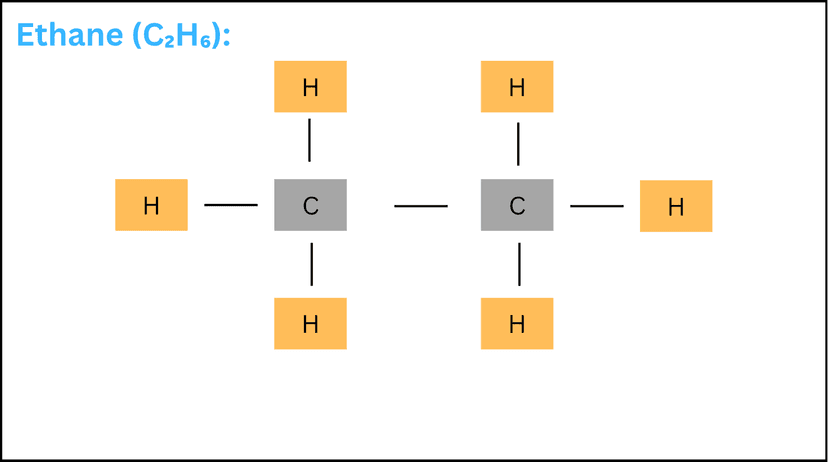
- Ethane (C₂H₆): Found in natural gas.
- Propane (C₃H₈): Used in LPG cylinders for cooking.
- Butane (C₄H₁₀): Used in cigarette lighters.
- Pentane (C₅H₁₂): Used in petrol as a fuel.
Structural Formula Example:
- For Ethane (C₂H₆): All connections are single bonds.
2. Unsaturated Hydrocarbons
Key Points
Definition:
- Unsaturated hydrocarbons are those which contain at least one double (C=C) or triple (C≡C) bond between the carbon atoms.
- Because of these multiple bonds, the carbon atoms are "unsaturated", or could still accept more hydrogen atoms if added.
Types and Their General Formulas:
- Alkenes: Contain at least one double bond (C=C); general formula CₙH₂ₙ.
- Alkynes: Contain at least one triple bond (C≡C); general formula CₙH₂ₙ₋₂.
Characteristics:
- These compounds are more reactive than saturated hydrocarbons.
- They commonly undergo addition reactions, where elements are added to the compound by breaking the double or triple bonds.
- Unsaturated hydrocarbons are often used as building blocks in the manufacture of plastics, rubbers, and chemicals.
- They contain fewer hydrogen atoms compared to the corresponding alkanes.
Examples:
Alkenes:
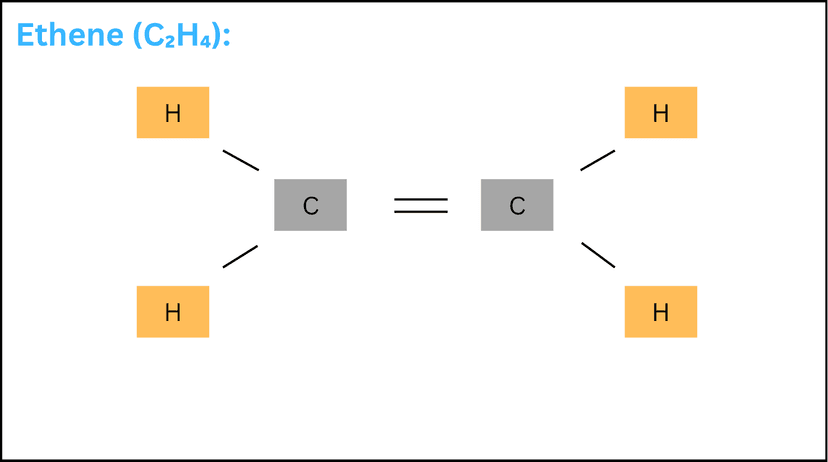
- Ethene (C₂H₄): Used to ripen fruits and make plastics (polyethylene).
- Propene (C₃H₆): Used to make polypropylene plastic.
- Butene (C₄H₈): Used in synthetic rubber production.
Alkynes:
- Ethyne (C₂H₂) / Acetylene: Used in welding and cutting metals.
- Propyne (C₃H₄): Used in organic synthesis.
- Butyne (C₄H₆): Also used in specialized chemical reactions.
Structural Formula Examples:
Ethene (C₂H₄):
Ethyne (C₂H₂):
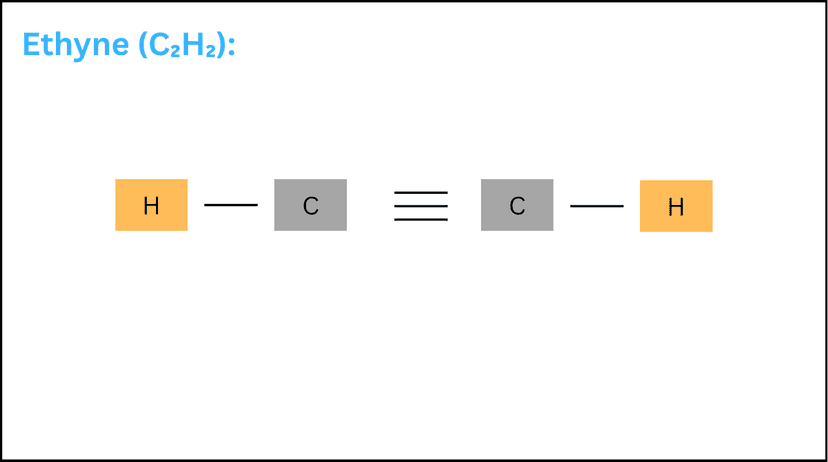
Notice the double bond in ethene and the triple bond in ethyne.
3. Observing Saturation: Activity
Activity: Bromine Water Test for Saturation
Objective:
To distinguish between saturated and unsaturated hydrocarbons using bromine water.
Materials Needed:
- Test tube
- Bromine water (orange in color)
- Sample of hexane (a saturated hydrocarbon)
- Sample of hexene (an unsaturated hydrocarbon)
- Dropper
Steps:
- Take two test tubes.
- Add about 2 mL of bromine water to each test tube.
- To the first test tube, add a few drops of hexane.
- To the second test tube, add a few drops of hexene.
- Shake both test tubes gently and observe the color change.
Observations:
- In the test tube with hexane, bromine water remains orange. (No reaction)
- In the test tube with hexene, the orange color disappears. (Bromine reacts with the double bond and gets "used up".)
Explanation:
- Saturated hydrocarbons do not react with bromine water, so the color does not change.
- Unsaturated hydrocarbons react with bromine, decolorizing the solution.
- This test helps to identify if a hydrocarbon is saturated or unsaturated.
4. Summary Table
| Feature | Saturated (Alkanes) | Unsaturated (Alkenes & Alkynes) |
|---|---|---|
| Bond type | Single (C–C) | Double (C=C) or Triple (C≡C) |
| Example (2 C atoms) | Ethane (C₂H₆) | Ethene (C₂H₄), Ethyne (C₂H₂) |
| Hydrogen content | Maximum | Less than alkanes |
| Reactivity | Less reactive | More reactive |
| Reaction with bromine | No reaction | Addition reaction; colorless |
5. Extra Tips and Fun Facts
- The word “saturated” comes from the idea that the molecule is "filled" with as many hydrogen atoms as it can hold.
- Many vegetable oils are unsaturated hydrocarbons, while animal fats are mostly saturated. That’s why oil can be turned into margarine by adding hydrogen (hydrogenation, turning unsaturated to saturated).
- The presence of double/triple bonds makes it possible to make plastics, rubbers, and more, just from hydrocarbons!
Scenario Based Questions
1. Scenario: Your school wants to switch to a fuel that burns cleaner and is easy to handle.
- Question: Would you suggest a saturated or unsaturated hydrocarbon, and why?
- Answer: I would suggest a saturated hydrocarbon like propane or butane because they burn cleanly, are less reactive, and are safe to store and transport as LPG.
2. Scenario: You are given two colorless liquids, one turns bromine water colorless and the other does not.
- Question: How would you classify these liquids?
- Answer: The liquid that turns bromine water colorless is an unsaturated hydrocarbon (contains double/triple bonds). The one that does not react is a saturated hydrocarbon (only single bonds).
3. Scenario: In the manufacture of synthetic plastics, a chemist has to choose between ethane and ethene.
- Question: Which compound should the chemist choose and why?
- Answer: The chemist should choose ethene (an unsaturated hydrocarbon) because its double bond allows it to undergo polymerization, essential for plastic production.
4. Scenario: You observe a chemical in the lab with the molecular formula C₃H₆.
- Question: Is this compound saturated or unsaturated? What is its likely name?
- Answer: The compound is unsaturated (fewer hydrogens compared to alkanes with 3 carbons). Its name is propene (an alkene).
5. Scenario: Your dietician tells you that unsaturated fats are healthier than saturated fats.
- Question: Based on the hydrocarbon structure, why might this be?
- Answer: Unsaturated fats have double bonds, making them more flexible and healthier for our bodies, while saturated fats have only single bonds and can increase cholesterol.
By breaking down hydrocarbon structures, reactions, and using simple activities, learning this topic can be both easy and fun!