
Communication Barriers
Barriers are obstacles that prevent effective communication. They often lead to misunderstandings and confusion. This effect is sometimes called the "Arc of Distortion."
Let's understand the key points about communication barriers in detail:
1. Lack of Proper Style or Feedback
Explanation:
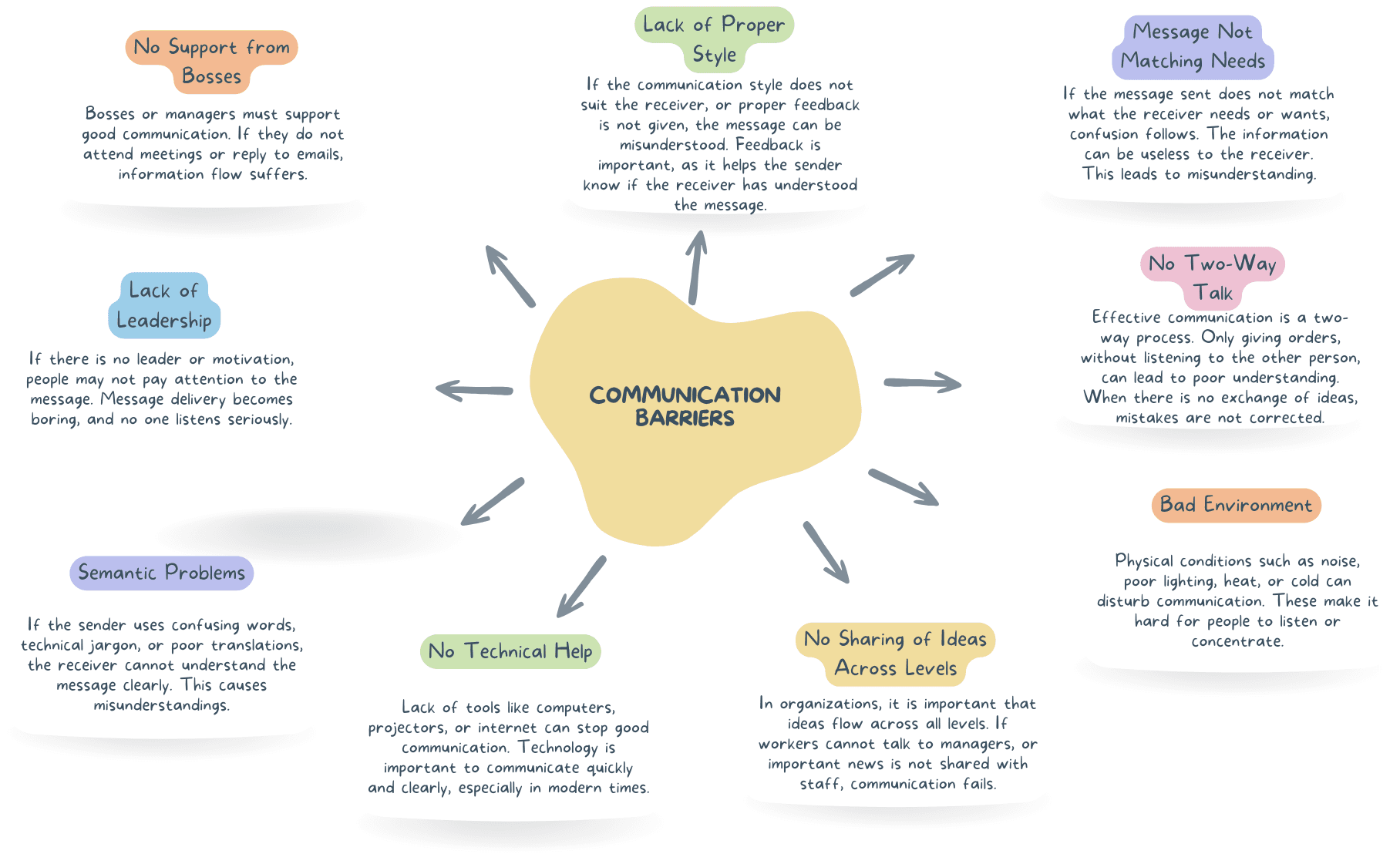
If the communication style does not suit the receiver, or proper feedback is not given, the message can be misunderstood. Feedback is important, as it helps the sender know if the receiver has understood the message.
If there is no feedback, errors can go unnoticed and cause problems.
Important Points:
- Feedback is a response confirming if the message is clear.
- Without feedback, mistakes are hard to spot.
Examples:
- A teacher tells students to finish homework, but does not check if they understood the instructions.
- A manager sends a complex email but does not ask if employees need help.
- Giving written instructions in English to a group who are comfortable in Hindi.
Fun idea:
Imagine a game of Chinese Whispers—messages can change greatly from the original because nobody checks or gives feedback!
2. Message Not Matching Needs
Explanation:
If the message sent does not match what the receiver needs or wants, confusion follows. The information can be useless to the receiver.
This leads to misunderstanding.
Important Points:
- The sender must know what the receiver needs.
- Wrong or irrelevant information wastes time.
Examples:
- Telling a mechanic about software problems (irrelevant information).
- Giving weather information to travelers who need train timings.
- A student asks for exam tips, but receives only summaries from the textbook.
3. No Two-Way Talk
Explanation:
Effective communication is a two-way process. Only giving orders, without listening to the other person, can lead to poor understanding.
When there is no exchange of ideas, mistakes are not corrected.
Important Points:
- Both people should talk and listen.
- Good communication is like a ping-pong game, not a one-way street.
Examples:
- A boss gives instructions but does not listen to workers’ ideas.
- Teachers lecture without letting students ask questions.
- Parents tell children what to do but do not listen to their problems.
4. Bad Environment (Noise, Weather)
Explanation:
Physical conditions such as noise, poor lighting, heat, or cold can disturb communication. These make it hard for people to listen or concentrate.
Important Points:
- Environment affects how well a message is sent and received.
- Too much noise, bad weather, or poor light can block understanding.
Examples:
- Trying to study in a noisy market.
- Talking during a thunderstorm.
- Discussing something important in a crowded, loud place.
5. No Sharing of Ideas Across Levels
Explanation:
In organizations, it is important that ideas flow across all levels. If workers cannot talk to managers, or important news is not shared with staff, communication fails.
Important Points:
- Good organizations allow for flow of ideas.
- Barriers in hierarchy block this flow.
Examples:
- Workers cannot talk to managers directly.
- Branches of a company do not share information.
- Important news does not reach staff because only bosses discuss it.
6. No Technical Help
Explanation:
Lack of tools like computers, projectors, or internet can stop good communication. Technology is important to communicate quickly and clearly, especially in modern times.
Important Points:
- Technology helps make messages clear and fast.
- Without it, communication can slow down or fail.
Examples:
- Online classes without a stable internet connection.
- Projecting slides when the projector is broken.
- Unable to email because office computers are too old.
7. Semantic Problems (Wrong Words, Translations)
Explanation:
If the sender uses confusing words, technical jargon, or poor translations, the receiver cannot understand the message clearly. This causes misunderstandings.
Important Points:
- Use simple language everyone understands.
- Translations should be accurate.
Examples:
- Using medical words with a non-doctor.
- Translation mistakes changing the message meaning.
- Two countries not understanding each other due to language barrier.
8. Lack of Leadership or Enthusiasm
Explanation:
If there is no leader or motivation, people may not pay attention to the message. Message delivery becomes boring, and no one listens seriously.
Important Points:
- Leaders make sure communication happens smoothly.
- Enthusiasm keeps people interested.
Examples:
- A teacher reads from the book in a dull tone.
- A team without a leader works with low interest.
- Students feel bored because the teacher shows no energy.
9. No Support from Bosses
Explanation:
Bosses or managers must support good communication. If they do not attend meetings or reply to emails, information flow suffers.
Important Points:
- Leaders should support and encourage communication.
- Their actions affect the whole group.
Examples:
- Bosses do not attend meetings.
- Managers do not reply to emails.
- Leaders do not help teams solve problems.
Mindmap
Types of Barriers
Personal Barriers
Explanation:
These are mistakes made by the sender, like forming the wrong message. The receiver then gets the wrong idea.
Examples:
- A friend says, "I am angry," but actually means "I am upset."
- A teacher says "this is easy," but students find it tough.
Semantic Barriers
Explanation:
These are problems in the meaning of words. Wrong words or poor translations confuse the receiver.
Examples:
- Using technical terms with people who do not know them.
- Mixing up "principal" (school head) and "principle" (rule).
Organizational Barriers
Explanation:
These are problems in the structure, rules, or authority chain in an organization.
Examples:
- Employees need permission from too many bosses to send a message.
- There are strict rules about who can share information.
Psychological Barriers
Explanation:
Emotions such as anger, sadness, or worry can act as mental blocks. If someone is upset, they may not listen or pay proper attention.
Examples:
- If you are angry, you may not listen carefully.
- A sad person cannot focus on a useful discussion.
Activity: Understanding Barriers through a Classroom Game
Objective:
To help students experience the effects of communication barriers firsthand.
Steps:
- Form a straight line with 8–10 students (stand one behind the other).
- The first student thinks of a short sentence and whispers it to the next student in line.
- Each student whispers what they heard to the next classmate, only once.
- The last student in line says the message out loud to everyone.
Observations:
- The final message is often quite different from the original sentence.
- Mistakes can happen due to noise, poor listening, unclear pronunciation, or misinterpretation.
- This activity shows how easily feedback, environment, and word meanings (semantics) can create barriers and change the message.
Elaboration (Key Points and Examples):
- Feedback: Nobody checks if the message is correct.
- Environment: Classroom noise or giggles can change the message.
- Semantics: Wrong word heard, new meaning formed.
Step-by-step Instructions:
- Ask for 8-10 volunteers to stand in a line.
- Give a simple sentence (like "My cat loves fish") to the first student privately.
- The first student whispers this to the second student.
- Continue until the message reaches the last student.
- Last student says aloud what they heard.
- Compare it to the original sentence.
What you will observe:
The two sentences are often very different. Some words are changed, others are forgotten. The meaning can be completely lost. This demonstrates how barriers can change messages, just like in real life!
How to Overcome Barriers
Key Points:
- Use simple language everyone understands.
- Always ask for feedback by saying, "Do you understand?"
- Be a good listener and pay attention to the speaker.
- Use technology and tools for clear instructions.
- Make sure communication is always a two-way process.
Examples:
- Teacher checks if students understand homework before ending class.
- Manager asks staff to repeat instructions for clarity.
- Using online tools like slides and videos to explain tough topics.
Scenario Based Questions
Scenario:: You notice your group project team misses important updates because the leader never asks for opinions.
- Question: What type of communication barrier is this? How could you solve it?
- Answer: This is a lack of two-way communication. The leader should ask for feedback and involve all members in discussions.
Scenario:: You try to tell your parents about a problem, but they are angry and not listening.
- Question: Which barrier is affecting communication here?
- Answer: This is a psychological barrier, as their emotions prevent them from listening properly.
Scenario:: You are in an online class, but your internet keeps breaking.
- Question: What kind of barrier is this, and what could help?
- Answer: This is a technical barrier. Good internet or recorded lessons could help overcome it.
Scenario:: Your friend uses computer jargon you do not understand.
- Question: Which barrier is stopping effective communication?
- Answer: Semantic barrier, because of confusing or technical words.
Scenario:: Important information only gets shared among senior school staff, and not students.
- Question: Which communication barrier is this, and how can it be resolved?
- Answer: This is an organizational barrier. The school can create meetings or notices to ensure everyone is informed.