
Importance of Communication
Communication is the basis of all human relationships. It helps people share ideas and understand each other. Through communication, we assign tasks, organize teams, share decisions, and build connections. Good communication makes life smoother and more enjoyable!
Let's learn about the key points of communication with fun examples.
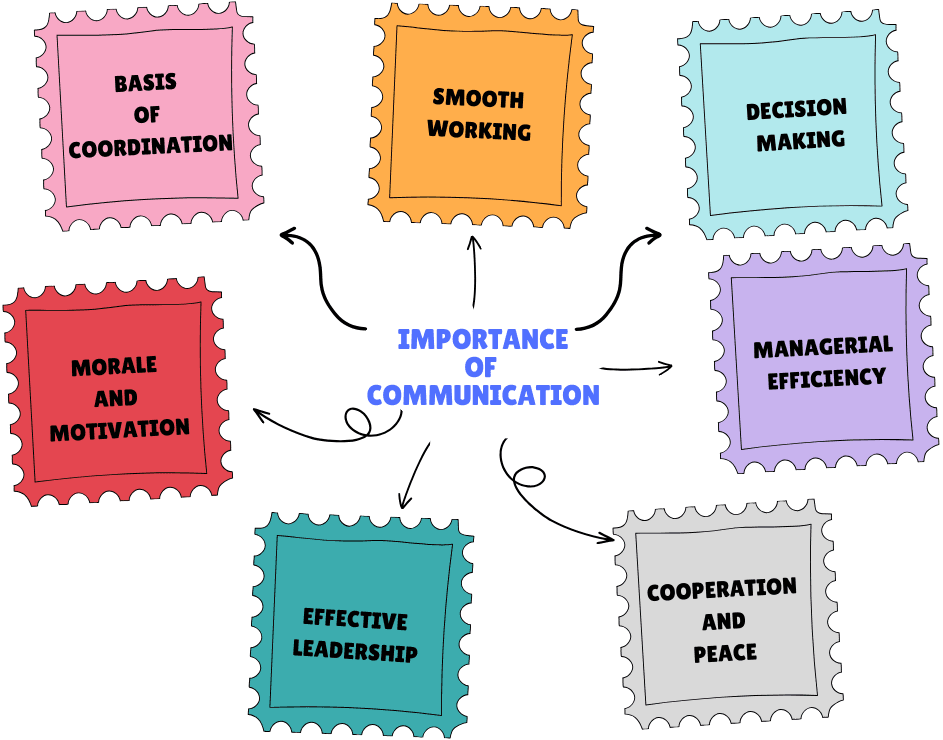
(i) Basis of Coordination
- Communication builds a bridge between people and departments.
- It helps explain common goals clearly. Teamwork becomes easier when everyone knows their role.
- Communication links everyone, so work happens smoothly and efficiently.
Examples:
- A school principal shares the exam schedule with teachers and students. This way, everyone prepares well in time.
- In a cricket team, the captain tells each player their specific role, like who will bat first or who will bowl next.
- In a hospital, doctors and nurses talk about a patient’s care so that everyone knows what to do.
Why is this important? Without communication, people may work in different directions, leading to confusion and mistakes.
(ii) Smooth Working
- With good communication, all team members know their tasks.
- This helps avoid confusion. It also ensures people and resources are used in the best way.
- Problems are solved quickly because everyone shares information.
Examples:
- A factory manager tells workers their shift timings clearly. This prevents people from coming at the wrong time.
- School office staff informs teachers about changes in the timetable. Teachers can plan their classes well.
- Event coordinators explain the schedule and roles for a school function. Each volunteer knows what to do.
Why is this important? Day-to-day work becomes smooth and mistakes are reduced. Everyone knows what to do and when to do it.
(iii) Decision Making
- Making good decisions needs the right information.
- Communication is how we collect and share this information.
- Without communication, choices become risky and weak.
Examples:
- The school principal asks teachers how many students need extra classes before planning them.
- Farmers talk to each other about the weather before planting seeds, so they make smart decisions about their crops.
- A group of doctors share patient reports and discuss treatment before an operation.
Why is this important? Right decisions save time, money, and effort. Lack of information can lead to failure.
(iv) Managerial Efficiency
- Managers give directions, set goals, and check progress through communication.
- This keeps the team working well and boosts performance.
- Instructions and feedback make sure everyone improves.
Examples:
- The head boy or girl assigns tasks to students for a school fair, making sure everyone has a job.
- A lab instructor demonstrates experiments and checks to see if students are following correctly.
- The store manager divides work among employees each day for better service.
Why is this important? A manager cannot be everywhere. Communication helps guide everyone at the same time, saving effort.
(v) Cooperation and Peace
- Open, two-way communication builds understanding and trust among people.
- Everyone feels heard. Differences get resolved in a friendly way.
- Cooperation and peace follow naturally.
Examples:
- Students working together on a group project discuss ideas, listen to each other, and share tasks.
- Staff meetings are held to solve problems and disagreements. Everyone speaks and everyone listens.
- Peace talks between countries work only if leaders communicate honestly and openly.
Why is this important? It is easy to solve small fights and misunderstandings if people talk openly and respect each other.
(vi) Effective Leadership
- Leaders use communication to guide and inspire people.
- They share their vision and encourage teamwork.
- Good leaders listen to concerns and energize the group.
Examples:
- A team captain gives an inspiring speech before a match, making everyone believe they can win.
- The principal motivates students during assembly, talking about hard work and success.
- A political leader speaks to the nation to share plans and gather support.
Why is this important? Great communicators become great leaders. They unite people and help everyone achieve success.
(vii) Morale and Motivation
- Regular appreciation, praise, and feedback keep team spirits high.
- Good communication makes people feel valued and respected.
- Happy, motivated people work better and stay connected.
Examples:
- A teacher praises a student in front of the whole class, boosting the student’s confidence.
- A coach congratulates the team after a win, encouraging them to play even better.
- The manager thanks employees for their hard work, which inspires them to do more.
Why is this important? People who feel special and appreciated give their best effort, making the whole team stronger.
Fun Activity: Building a Communication Chain
Activity Instructions:
- Make a line of 10 students.
- The teacher will whisper a short sentence (e.g., "The sun rises in the east") into the ear of the first student.
- Each student will then whisper what they heard to the next student in line, one by one.
- The last student will say the sentence out loud.
Observations:
- Often, the final message is very different from the original sentence.
- This shows how messages can get mixed up if not communicated clearly.
- It highlights the need for clear and accurate communication in all situations.
What we learn:
- Simple mistakes can change the meaning of a message.
- Clear and careful communication is important for success at school, sports, or home.
Scenario-based Questions and Answers
-
Scenario: You are organizing a school play with your classmates.
- Question: How can communication help you assign roles and practice sessions?
- Answer: By discussing and sharing information, everyone gets their role quickly and knows when to practice, making the preparation more organized and fun.
-
Scenario: There is a change in your school bus route.
- Question: Why is it important for the bus driver to communicate this to students and parents?
- Answer: If everyone knows the new route early, students reach school safely and on time. Lack of information could make some students miss the bus.
-
Scenario: Your science teacher divides the class into groups for a project.
- Question: What should your group do to work well together?
- Answer: You should communicate clearly, share ideas, and listen to each other to finish the project smoothly.
-
Scenario: There is a misunderstanding between two friends about a homework assignment.
- Question: How can good communication solve their problem?
- Answer: They can talk openly, explain their points of view, and clear up the misunderstanding easily.
-
Scenario: You want to thank your team after winning a football match.
- Question: How does this communication impact team morale?
- Answer: It makes team members feel appreciated and encourages them to keep working hard in future matches.