
Flow of Communication and 7 Cs of Effective Communication
Flow of Communication
Organizations rely on five main flows of communication. Each flow helps ensure tasks are completed, information is shared, and the workplace functions smoothly. Let’s look at each of these flows:
1. Downward Communication
- Information travels from higher management to lower levels.
- Examples include a boss giving feedback, managers assigning tasks, or policy announcements.
- Examples:
- A principal telling teachers about a new school rule.
- A department manager emailing staff to start a new project.
- A business owner sharing yearly goals with employees.
Important Points:
- Ensures employees know what to do.
- Good for sharing plans, instructions, or feedback.
2. Upward Communication
- Information flows from lower levels to higher management.
- Employees share ideas, feedback, reports, or grievances.
- Examples:
- An employee emailing their boss about a workplace problem.
- Students submitting a suggestion box note to the principal.
- Workers reporting weekly progress to supervisors.
Important Points:
- Helps management understand issues or team morale.
- Encourages workers to share their thoughts.
3. Horizontal/Lateral Communication
- Takes place between people at the same level.
- Used for planning, coordination, or problem-solving.
- Examples:
- Teachers discussing curriculum strategies together.
- Colleagues working on a project sharing updates.
- Two store managers exchanging tips on sales methods.
Important Points:
- Saves time and prevents misunderstandings.
- Encourages teamwork.
4. Diagonal Communication
- Communication between different levels but across departments.
- For example, a manager in the finance department talks to a junior engineer in maintenance.
- Examples:
- An HR manager discussing leave policy with a junior IT staff member.
- A project leader in sales consulting a junior accountant for a client’s data.
- A health officer communicating with administrative support staff in another department.
Important Points:
- Bridges departmental gaps.
- Useful for special projects or tasks needing multiple departments.
5. External Communication
- Exchange of information with people or groups outside the organization.
- Involves vendors, customers, banks, or government bodies.
- Examples:
- A company emailing a supplier about a delayed delivery.
- School administration talking to parents about an event.
- A shopkeeper phoning the bank to clarify account details.
Important Points:
- Builds partnerships.
- Keeps outside stakeholders informed.
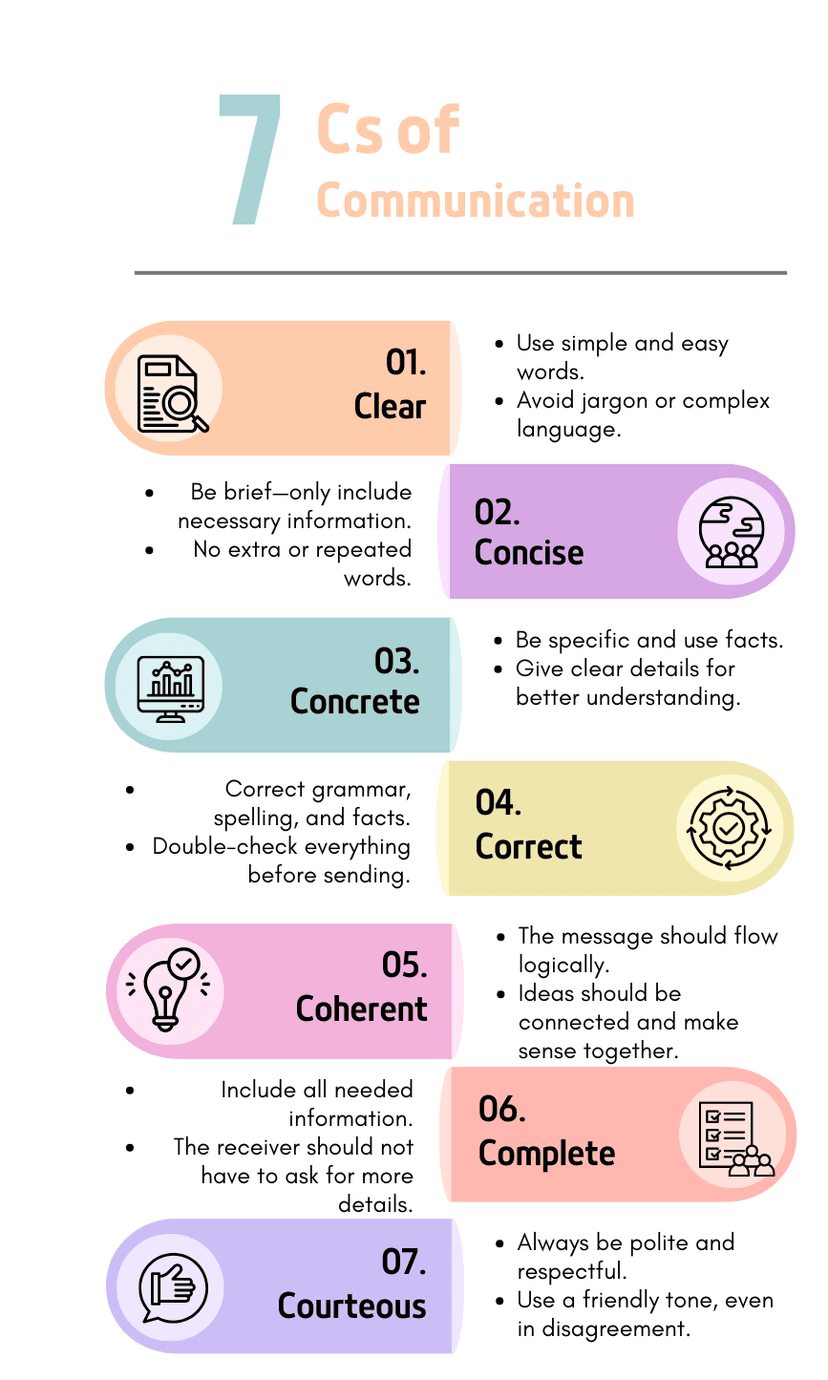
7 Cs of Effective Communication
To ensure your message is received well and understood, use the 7 Cs:
1. Clear
- Use simple and easy words.
- Avoid jargon or complex language.
- Examples:
- “Bring your books tomorrow” instead of “You are expected to furnish the required materials on the morrow.”
- “Meeting at 10 A.M.” is clear.
- “Use blue pen for notes,” not “Utilize azure ink instruments for annotation.”
Important Points:
- Helps avoid confusion.
- Receivers easily understand the message.
2. Concise
- Be brief—only include necessary information.
- No extra or repeated words.
- Examples:
- “Submit your homework today.”
- In an SMS: “Quiz at 2 PM.”
- “Fee due Friday,” not “You are reminded yet again about the approaching deadline for fee submission which is this Friday.”
Important Points:
- Saves time for both sender and receiver.
3. Concrete
- Be specific and use facts.
- Give clear details for better understanding.
- Examples:
- “Deliver 20 notebooks by Monday.”
- “The event starts on 1st March, 2024.”
- “Our profit increased by 15% this year.”
Important Points:
- Makes your message believable and reliable.
4. Correct
- Correct grammar, spelling, and facts.
- Double-check everything before sending.
- Examples:
- Double-checking your report for spelling errors.
- Providing the right meeting location: “Room 22, First Floor.”
- Using accurate data: “Our sales were Rs. 2 lakhs, not Rs. 20 lakh.”
Important Points:
- Builds trust.
- Avoids costly mistakes.
5. Coherent
- The message should flow logically.
- Ideas should be connected and make sense together.
- Examples:
- A paragraph where sentences all relate to one main point.
- Explaining steps in order: first, then next, and finally.
- Listing instructions in a logical sequence.
Important Points:
- Easy for the receiver to follow.
- Avoids confusion.
6. Complete
- Include all needed information.
- The receiver should not have to ask for more details.
- Examples:
- “Please submit the report by Friday to my desk, with your signature.”
- “Tomorrow’s trip: bring lunch, water bottle, hat.”
- “Workshop on 5th July, 10 AM, Room 12, bring your ID.”
Important Points:
- Saves time by reducing follow-up questions.
7. Courteous
- Always be polite and respectful.
- Use a friendly tone, even in disagreement.
- Examples:
- “Thank you for your feedback.”
- “Please let me know if you need help.”
- “Could you kindly send the document by tomorrow?”
Important Points:
- Encourages positive relationships.
- Makes the receiver more willing to respond.
Scenario-Based Questions
-
Scenario: You notice that your friend is confused by the teacher’s instructions.
- Question: Which ‘C’ of communication could have been improved, and how?
- Answer: ‘Clear’—the teacher should use simple and direct words so students can understand instructions.
-
Scenario: A sales manager shares details about a new product with the entire department, but only half respond.
- Question: Which direction is this communication taking? What could improve it?
- Answer: Downward communication. Making the message more ‘complete’ and concise may help everyone respond.
-
Scenario: An accountant approaches the IT supervisor directly to clarify a payroll issue.
- Question: What type of communication flow is this?
- Answer: Diagonal communication—because it is between different departments and hierarchy levels.
-
Scenario: A student emails their teacher about an issue with homework submission software.
- Question: What communication flow is this? Suggest a 7 C to make the email better.
- Answer: Upward communication. Using ‘concrete’ detail about the issue helps the teacher solve it faster.
-
Scenario: Two classmates are working together to prepare a science project.
- Question: What communication flow are they using? Which ‘C’ is most important here, and why?
- Answer: Horizontal communication. ‘Coherent’ is most important so both can follow each other’s ideas step-by-step.