
Human Brain: Structure, Parts, Functions, and Protection
Hello students! Let's explore the HUMAN BRAIN—a fascinating organ that controls everything we do! We’ll break down its structure, main parts, each function, and how it’s protected. Let’s make learning fun and easy!
1. Structure of the Human Brain
Key Points:
- The human brain is the major part of the central nervous system.
- It looks soft, jelly-like, and is greyish-white.
- It weighs about 1.2 to 1.4 kg in adults.
- It has about 100 billion neurons (nerve cells).
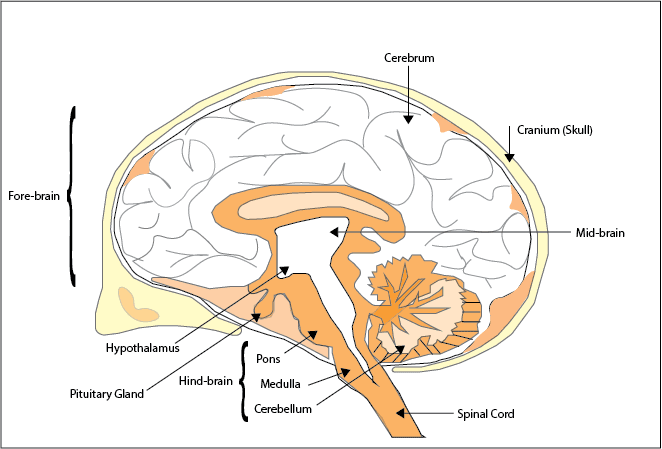
- The brain is divided into three main parts:
- Forebrain
- Midbrain
- Hindbrain
- It is present inside the skull (cranium), which protects it.
Elaboration:
- The brain is a delicate organ packed with billions of neurons. Think of it as a super computer that controls all thoughts, senses, memories, and every action.
- It is divided into three broad regions (forebrain, midbrain, hindbrain), each having specific functions.
- The outer surface is wrinkled, which increases its surface area to accommodate more neurons.
Examples:
- When you solve a tricky math problem, your brain’s cortex (part of the forebrain) is busy processing!
- When you feel ticklish or touch something soft, your brain is processing that sense.
- Even when you sleep, parts of your brain are active, controlling breathing and heart rate.
2. Parts of the Brain and Their Functions
A. Forebrain
Key Points:
- Largest part of the brain.
- Includes: Cerebrum, Thalamus, and Hypothalamus.
- Handles thinking, sensing, memory, and voluntary actions.
1. Cerebrum
- Most developed and largest part (~80% brain weight)
- Two hemispheres (left and right), joined by the corpus callosum.
- Outer surface has folds (gyri and sulci) for more surface area.
- Four lobes: frontal, parietal, temporal, occipital.
Functions:
- Thinking, reasoning, intelligence, memory, and emotions.
- Controls senses: touch, vision, hearing, taste, smell.
- Controls voluntary actions (e.g., movement of arms or speech).
Examples:
- Remembering names for your science test (memory).
- Enjoying your favorite music (hearing).
- Planning a birthday party (reasoning and planning).
2. Thalamus
- Located beneath cerebrum.
- Works as a relay station for sensory information.
- Connects sensory impulses (e.g., pain, touch, temperature) to the cerebrum.
Examples:
- When you touch a hot pan, thalamus helps relay that pain signal to the cerebrum.
- Feeling someone pat you on the back.
- Noticing the difference between a hot and cold object by touch.
3. Hypothalamus
- Small but powerful! Found below the thalamus.
- Maintains homeostasis (body balance) by controlling:
- Hunger, sleep, thirst, emotions, and body temperature.
- Controls pituitary gland (master gland), so regulates many hormones.
Examples:
- You feel hungry just before lunchtime—thank your hypothalamus!
- Sweating on a hot day or shivering when cold.
- Becoming sleepy at night as hypothalamus responds to your body clock.
B. Midbrain
Key Points:
- Smallest region.
- Connects forebrain to hindbrain.
- Controls reflex actions involving sight and sound.
Functions:
- Involuntary reflexes for eyes and ears.
- Helps move eyes and neck quickly to react to sudden stimuli.
Examples:
- Turning your head rapidly when you hear a loud clap.
- Your pupils shrinking in bright sunlight.
- Reflexively blinking when something comes close to your eyes.
C. Hindbrain
Key Points:
- Located at the lower back part of the brain.
- Includes: Cerebellum, Pons, Medulla oblongata.
- Controls balance, posture, coordination, and vital involuntary actions.
1. Cerebellum
- Under the cerebrum.
- Controls balance, posture, and coordination.
- Ensures smooth and accurate movements.
Examples:
- Balancing on one foot or a cycle.
- Walking straight in a line.
- Dancing or playing sports smoothly.
2. Pons
- Lies above the medulla and below the midbrain.
- Acts as a bridge—connects different brain regions.
- Controls facial expressions, some eye movements, and breathing rhythm.
Examples:
- Smiling or laughing at a joke.
- Breathing deeply while resting.
- Blinking or tearing up when emotional.
3. Medulla Oblongata
- Lowest part of the brain stem.
- Connects brain to spinal cord.
- Controls important involuntary actions: heartbeat, breathing, sneezing, swallowing.
Examples:
- Breathing while asleep.
- Heart beating whether awake or asleep.
- Sneezing when you inhale dust.
3. Protection of the Human Brain
Key Points:
- The brain is protected by three major features:
- Cranium (skull bones)
- Meninges
- Cerebrospinal Fluid (CSF)
1. Cranium
- Hard, bony structure.
- Outermost physical shield to prevent injuries.
Example: Wearing a helmet adds extra layer on your cranium while cycling!
2. Meninges
- Three layers of membranes:
- Dura mater (tough outer layer)
- Arachnoid (middle web-like layer)
- Pia mater (inner delicate layer)
- Provide cushioning and extra protection.
Example: Like bubble wrap inside a box, meninges protect the brain from jerks.
3. Cerebrospinal Fluid (CSF)
- A clear fluid between the meninges and brain tissue.
- Acts as a shock absorber.
- Delivers nutrients, removes wastes, and keeps the brain “floating” to avoid impact.
Example: If you jump and land, CSF helps prevent your brain from hitting the skull directly.
4. Activity: Test Your Balance! (To experience the Cerebellum’s role)
Activity Steps:
- Stand on one leg and close your eyes.
- Hold your arms out for balance.
- Try to stay steady for at least 30 seconds.
Observations:
- It's hard to keep balance without vision, showing your cerebellum works with sense organs to keep you upright.
- You may sway or fall if the cerebellum, ears, or eyes are not working together.
Elaboration: This activity shows the importance of the cerebellum in maintaining balance and posture.
5. Scenario-Based Questions and Answers
1. Scenario: You see your friend touch a hot pan and instantly withdraws their hand.
- Question: Which parts of the brain are mainly involved here?
- Answer: The thalamus relays the pain signal to the cerebrum, which helps the person realize the pain and act.
2. Scenario: In a dark room, someone turns on the light suddenly and your pupils shrink.
- Question: Which brain region is responsible for this response?
- Answer: The midbrain controls the reflex action of pupil adjustment.
3. Scenario: You are balancing on a beam during sports class.
- Question: Which part of your brain is mainly working?
- Answer: The cerebellum regulates your balance and coordination.
4. Scenario: You are breathing regularly while sleeping at night.
- Question: Which brain part ensures this continuous breathing?
- Answer: The medulla oblongata in the hindbrain controls involuntary breathing.
5. Scenario: After skipping breakfast, you feel hungry and tired at school.
- Question: Which structure tells you that you are hungry and need to eat?
- Answer: The hypothalamus senses your body’s need for food and signals hunger.
Remember:
- The forebrain thinks and senses.
- The midbrain handles reflexes.
- The hindbrain manages balance and involuntary actions.
- The cranium, meninges, & CSF protect your brain.
Learning about the brain teaches us how amazing our bodies are. Have fun, stay curious, and keep asking questions!