
CBSE Class 10 Physics: Electric Current and Circuit
Welcome to an exciting journey into the world of electricity! We’ll learn how electric current flows, what makes up an electric circuit, and how to represent them with circuit diagrams. Let’s break everything down, make learning fun, and explore with examples, activities, and scenario-based questions.
1. Electric Current
Key Points
(A) Definition of Electric Current
- Electric current is the flow of electric charges (generally electrons) through a conductor like a copper wire.
- The direction of current is taken from the positive terminal to negative terminal outside the source (conventional direction).
Important Points:
- The actual charge carriers are electrons, but their movement is taken as opposite to current flow.
Formula:
Where:
- = Current (Amperes, A)
- = Charge (Coulombs, C)
- = Time (seconds, s)
1 Ampere:
If 1 coulomb of charge flows in 1 second, the current is 1 ampere.
Examples:
- Torch Bulb: When you turn on a torch, electric current flows from the battery through the bulb, making it glow.
- Charging a Phone: Plugging in your phone allows current to flow and recharge the battery.
- Ceiling Fan: When you turn on the switch, current flows through the fan’s motor, and the blades rotate.
(B) Direction of Electric Current
- Conventional direction: From positive to negative.
- Direction of electron flow: From negative to positive (opposite to the conventional).
Example:
- Simple Battery Circuit: In a battery and bulb setup, the current in the wire flows from the positive terminal to the negative.
- TV Remote: When pressing a button, current flows from one end of the battery to the other, completing the circuit inside.
2. Electric Circuit
Key Points
(A) Definition of Electric Circuit
- An electric circuit is a closed conducting path through which current can flow.
- If the circuit is open, the flow stops; if closed, current flows unhindered.
Components:
- Electric cell/battery (source).
- Connecting wires (path for current).
- Switch/key (turn current on or off).
- Load (bulb, fan, etc.).
Examples:
- Bulb with Battery: Wires connect battery to bulb, bulb glows when switch is on (closed).
- Doorbell: Pressing the button completes the circuit and rings the bell.
- String of Fairy Lights: Current flows through all bulbs in a closed circuit.
(B) Open and Closed Circuits
- Open circuit: There’s a break (e.g., switch is off); no current flows, so devices won’t work.
- Closed circuit: No break; the path is complete; current flows.
Examples:
- Switch Off Light: When switched off, the light goes off – the circuit is open.
- Remote Controlled Car: Turning on the remote completes the circuit, powering the car.
- Broken Wire: Even if the device is “on,” a broken wire makes it an open circuit, so no function.
3. Circuit Diagrams and Symbols
Key Points
(A) Why Use Circuit Symbols?
- Easier to draw and understand than actual pictures.
- Standardized symbols are understood worldwide.
- Save time and avoid confusion!
(B) Important Circuit Symbols
Here’s the table with Circuit Symbols for few common elements:
| Component | Symbol | Description |
|---|---|---|
| Cell or Battery |  | Source of energy |
| Cell combination |  | Two or more cells connected together |
| Switch (open) |  | Circuit open — no current flows |
| Switch (closed) |  | Circuit closed — current flows |
| Bulb / Lamp |  | Gives light when current passes |
| Resistor |  | Restricts current |
| Variable Resistor |  | The amount of resistance can be adjusted |
| Ammeter |  | Measures current; connected in series |
| Voltmeter | 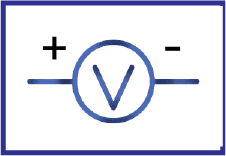 | Measures voltage; connected in parallel |
(C) Drawing a Simple Circuit Diagram
Let’s have a cell, a switch, and a bulb, all connected in a loop:
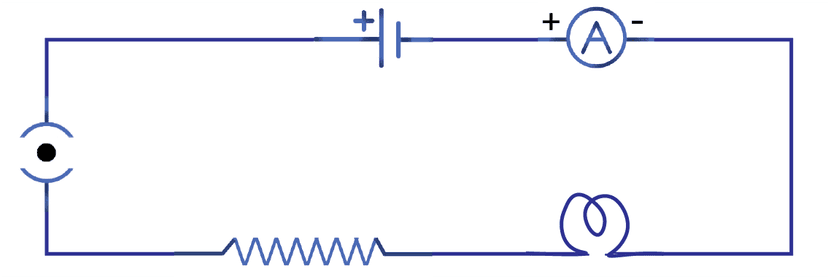
- The current flows from the positive end of the cell, through the switch (when closed), then through the bulb, and returns to the negative end.
Examples:
- Torch Circuit: Battery | Switch | Bulb | back to Battery.
- Class Experiment: Connecting a battery, switch, and a small lamp with wires to observe if the lamp glows when the circuit is completed.
- Room Light: Wall switch (key) controls the lamp by opening or closing the circuit.
4. Activity: To Show Current Flows Only in a Closed Circuit
Step-by-Step Instructions:
Materials Needed:
- A dry cell (battery).
- A small bulb.
- Switch (or use connecting/disconnecting the wire).
- Some connecting wires.
Procedure:
- Connect the positive terminal of the battery to one end of the bulb using a wire.
- Connect the other end of the bulb back to the negative terminal of the battery.
- Insert a switch or simply keep one wire end free.
- Observe: Bulb does not glow when the switch is open or the wire is disconnected.
- Now, close the switch or connect the free wire.
- Observe: Bulb glows! The circuit is complete, and current flows.
Observations:
- Bulb glows only when the circuit is closed.
- No matter how good the components are, an open circuit will not pass current.
Examples/Variations:
- Try connecting two bulbs in the same circuit and see if both glow (more on this in series/parallel circuits).
- Use a fan or any device as the load—the same principle applies.
5. Important Points to Remember
- Current will not flow in an ‘open’ circuit.
- Circuit diagrams use symbols for quick and universal understanding.
- Direction of current in diagrams is shown using arrows (conventional direction).
- Good conducting wires are essential for the smooth flow of current.
Scenario Based Questions
-
Scenario: You want to test if a wire is broken inside a cord without opening the insulation.
- Question: How can a simple circuit help?
- Answer: Connect a bulb and battery across the wire. If the bulb does not glow, the wire may be broken inside.
-
Scenario: You see a bulb in your home does not glow even when the switch is on.
- Question: List two possible reasons using what you learned about circuits.
- Answer: (i) The bulb filament is broken (open circuit inside the bulb). (ii) The wires in the circuit are disconnected or the fuse is blown, creating an open circuit.
-
Scenario: You are designing a toy car. The car should move only when you push a button.
- Question: What must you include in your circuit and why?
- Answer: Include a switch (button) in your circuit. The switch allows you to close the circuit and let current flow only when you want the car to move.
-
Scenario: In a classroom activity, your friend connects a battery and bulb but the bulb doesn’t glow. The teacher asks you to troubleshoot.
- Question: What steps will you take?
- Answer: (1) Check that all wires are connected and forming a closed loop. (2) Check the battery and bulb to ensure both are functional. (3) Ensure there are no loose connections.
-
Scenario: You see a diagram with battery, bulb, and switch using symbols.
- Question: How will you determine if the bulb will glow?
- Answer: Check if the circuit forms a closed loop and if the switch symbol shows it is in the ‘closed’ position.
Summary Table
| Term | Definition | Example |
|---|---|---|
| Electric Current | Flow of charge through conductor | Torch bulb glowing |
| Electric Circuit | Closed path for current flow | Doorbell |
| Circuit Diagram | Symbolic representation of electric circuit | Torch drawing |
Remember, electricity powers our world! Keep experimenting, stay curious, and always be safe while working with electric circuits.