
Resistance of a System of Resistors
A. Why Combine Resistors?
- In many electric circuits, the resistance value we need may not be available as a single resistor.
- By connecting resistors in different ways, we can produce almost any value of resistance required.
- This helps in controlling current flow and protecting devices.
Example 1:
Suppose you have only 2 Ω and 3 Ω resistors but you need a resistor of 5 Ω. You can connect both in series to get 5 Ω.
Example 2:
You need less than 2 Ω resistance but have only two 4 Ω resistors. You can connect them in parallel to get 2 Ω.
Example 3:
In making electrical toys or repairs, we create special resistance by combining available resistors.
B. Series Combination of Resistors
Definition:
Resistors are in series if they are connected end-to-end, so the same current passes through each resistor, one after another.
Key Points:
- Total resistance increases:
- The equivalent resistance is the sum of all resistances.
- Formula:
- Current is the same:
- The same amount of current flows through each resistor.
- Voltage divides:
- The total voltage gets shared between the resistors, depending on their resistance values.
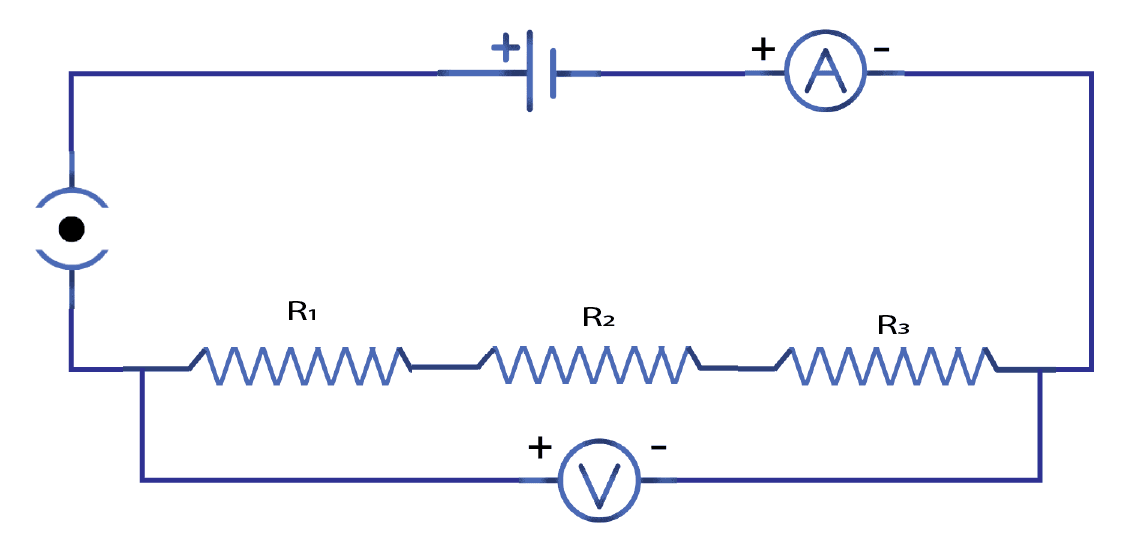
Examples:
Example 1:
Three resistors of 2 Ω, 3 Ω, and 5 Ω are connected in series.
Example 2:
A toy car uses two 1.5 Ω resistors in series.
Example 3:
Fairy lights in series: If one bulb fails, the whole string goes off.
Why does total resistance increase?
Think of a narrow path in a park. If you put three such paths one after another, it takes more effort to walk through all. Similarly, current "struggles" against more resistors in series.
C. Parallel Combination of Resistors
Definition:
Resistors are in parallel if both their ends are connected together—so each resistor gets the same voltage, but current divides among them.
Key Points:
- Total resistance decreases:
- The equivalent resistance (R) is always less than the smallest resistor.
- Formula:
- Current divides:
- The total current splits between the resistors.
- More current flows through smaller-valued resistors.
- Voltage is the same:
- Each resistor has the same voltage across it.
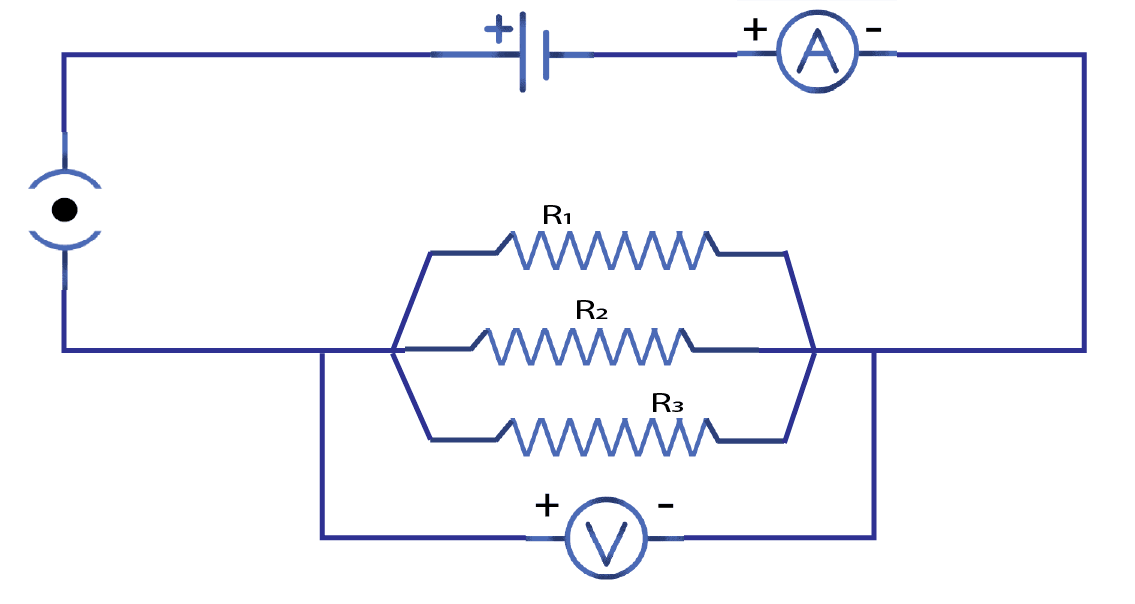
Examples:
Example 1:
Three resistors—2 Ω, 3 Ω, and 6 Ω—are in parallel:
Example 2:
Two resistors, each 4 Ω, in parallel:
Example 3:
Home appliances—each appliance connected to the mains supply gets the same 220 V, but can be switched ON or OFF independently.
Why does resistance decrease?
Think of water flowing through several pipes at once. The flow becomes easier, so resistance drops.
D. Activity: Verifying Series and Parallel Combination
Activity 1: Series Combination
Aim:
To verify that the total resistance in series increases.
Materials Needed:
- Three resistors of known values (say 2 Ω, 3 Ω, 5 Ω)
- Battery (say 6 V)
- Connecting wires
- Ammeter
- Voltmeter
Steps:
- Connect the three resistors end-to-end to form a series circuit.
- Connect the battery, ammeter in series, and voltmeter across the battery.
- Note the current using the ammeter.
- Calculate expected total resistance: .
- Use Ohm’s law () to calculate resistance from experimental values.
Observation:
The calculated resistance from the experiment matches the sum of individual resistors.
Activity 2: Parallel Combination
Aim:
To verify that the total resistance in parallel decreases.
Materials Needed:
- Three resistors of known values (use 2 Ω, 3 Ω, and 6 Ω)
- Battery (6 V)
- Connecting wires
- Ammeter
- Voltmeter
Steps:
- Connect all three resistors so that both ends join at common points (parallel).
- Connect battery, ammeter in series to whole circuit, and voltmeter across resistors.
- Note total current with the ammeter.
- Use Ohm’s law (), and compute experimental resistance ().
- Compare with calculated value:
Observation:
The resistance found experimentally is less than the smallest resistor.
E. Summary Table
| Arrangement | Formula | Current | Voltage/PD |
|---|---|---|---|
| Series | Same for all | Divided between them | |
| Parallel | Divides/branches | Same for all |
F. More Real-life Examples
Series:
- Decorative festoon lights
- Christmas light strings (old models)
- LED strips
Parallel:
- Household wall sockets
- Electrical plug boards
- Ceiling fans and lights in houses
G. When to Use Which?
- Use Series to increase resistance or get a certain voltage drop at each part.
- Use Parallel to decrease resistance, or to keep the same voltage for all devices.
Scenario Based Questions
-
Scenario: You have three identical bulbs and want each to glow equally bright at 220 V, but you want the overall resistance to decrease.
- Question: How should you connect the bulbs?
- Answer: Connect the bulbs in parallel. This ensures each gets 220 V and the overall resistance is lower.
-
Scenario: In your circuit, if one resistor fails and all other devices stop working immediately, what type of connection is present?
- Answer: It is a series connection. When one component breaks, the circuit becomes incomplete.
-
Scenario: You wish to limit the current in a simple torch circuit. Which resistor combination will you choose?
- Answer: Use resistors in series. This increases the total resistance and limits current.
-
Scenario: If three wires/pipes are laid in parallel between two tanks, water can flow easier. How does this relate to electrical resistors?
- Answer: Similarly, resistors in parallel provide more paths for current, so resistance decreases and current increases.
-
Scenario: Suppose an appliance in your house stops working, but all other appliances work perfectly.
- Answer: The appliances are connected in parallel. This ensures the rest can function if one fails.
H. Summary
- Series: Total resistance increases, current stays same, voltage divides.
- Parallel: Total resistance decreases, current divides, voltage stays same.
- Choosing the right combination helps us control how electricity flows.
Let’s keep learning and having fun with circuits!
If you’d like more problem practice or step-by-step calculations on real circuits, just let Mizu know.