
Chain Stores or Multiple Shops
Chain stores, also called multiple shops, are a popular type of retail organisation. Let us explore this concept in detail to make it fun and easy to understand.
1. Definition and Basic Concept
- Chain stores or multiple shops are networks of retail shops.
- These are owned and operated by manufacturers or intermediaries.
- They are set up in different localities across the country.
- They all look similar and sell the same standardised, branded products.
- Usually, these shops sell items that have rapid sales turnover.
- All stores are controlled by one organisation, and have the same sales and display strategies.
Examples:
- Bata Shoe Stores: You will find Bata shops in almost every city, looking the same and selling only Bata products.
- McDonalds: Every McDonald's outlet has similar interiors, menus, and uniforms.
- Raymond Shops: Exclusive Raymond garment stores across India follow the same theme and branding.
2. Features of Chain Stores
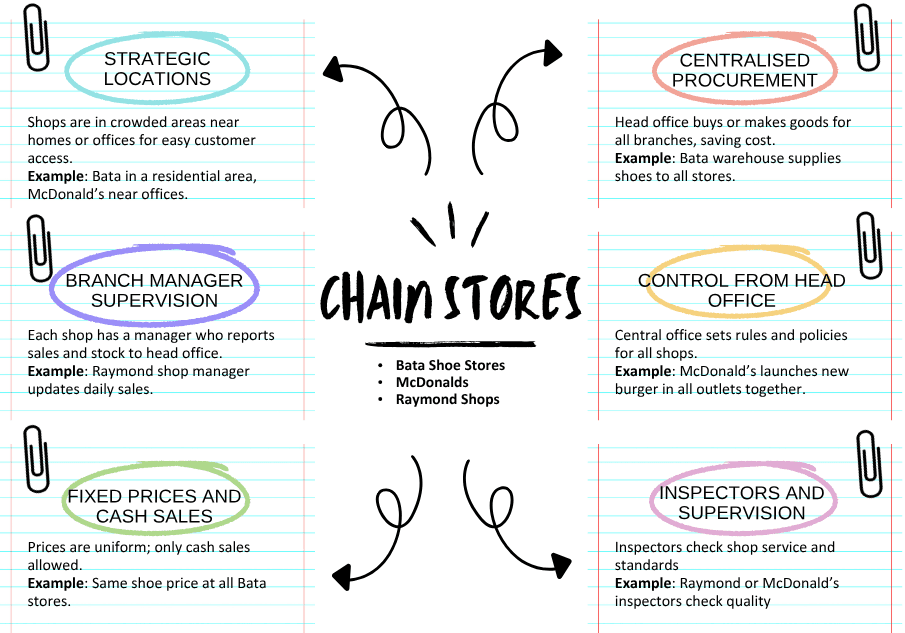
a) Strategic Locations
- Chain stores are opened in populous localities.
- The aim is to be close to customers, whether near their home or workplace.
- No need for customers to travel far to a central market.
Examples:
- A Bata store in a busy residential area.
- A McDonalds near a large office building.
- A Raymond shop inside a prominent shopping mall.
b) Centralised Procurement
- One head office handles purchase or manufacturing for all shops.
- Goods are sent to shops as needed.
- This system saves operation costs.
Examples:
- Bata’s main warehouse sends shoes to every Bata store across India.
- McDonald’s central kitchen supplies ingredients to all outlets in a city.
c) Branch Manager Supervision
- Every shop is directly supervised by a Branch Manager.
- The manager is responsible for daily tasks.
- Reports on sales, cash, and stock needs are sent daily to the head office.
Examples:
- A Bata shop manager submits daily sales and stock updates.
- The Raymond shop manager requests extra fabric stock after big sales.
d) Control from Head Office
- The central office decides policies.
- Head office makes sure each shop follows the same rules.
Examples:
- If McDonalds launches a new burger, all outlets start serving it at the same time.
- Bata introduces a new shoe design in every shop nationwide.
e) Fixed Prices and Cash Sales
- Prices are set and do not change between shops.
- Only cash sales are allowed.
- Cash from sales is deposited daily in a local bank and reported.
Examples:
- Everyone pays the same price for shoes at any Bata shop.
- McDonalds only accepts cash payments and applies the same prices everywhere.
f) Inspectors and Supervision
- Head office appoints inspectors.
- Inspectors check shop quality, service, and rule compliance.
Examples:
- An inspector visits a Raymond outlet to check customer service.
- McDonalds' quality manager ensures uniform fries taste the same everywhere.
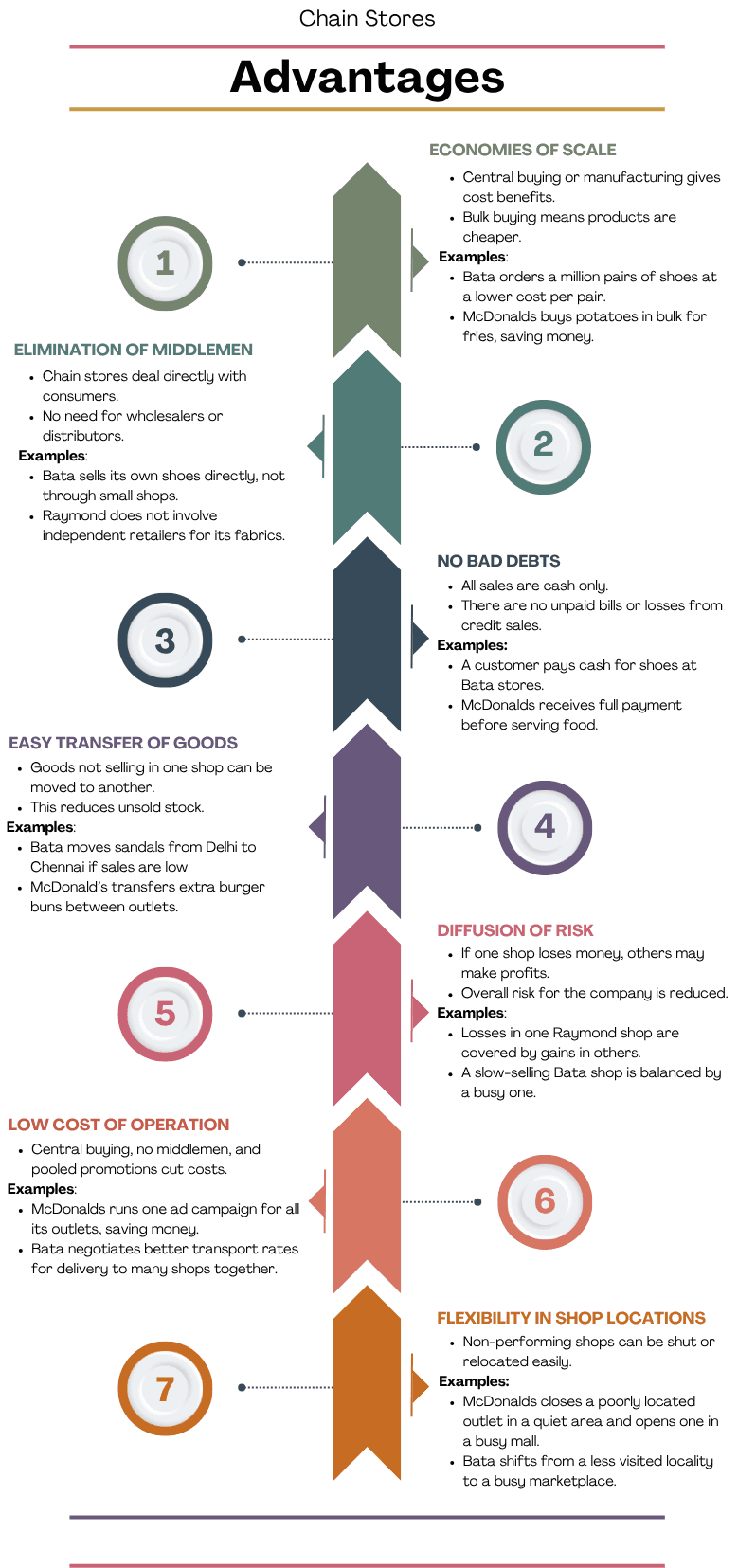
3. Advantages of Chain Stores
I. Economies of Scale
- Central buying or manufacturing gives cost benefits.
- Bulk buying means products are cheaper.
Examples:
- Bata orders a million pairs of shoes at a lower cost per pair.
- McDonalds buys potatoes in bulk for fries, saving money.
II. Elimination of Middlemen
- Chain stores deal directly with consumers.
- No need for wholesalers or distributors.
Examples:
- Bata sells its own shoes directly, not through small shops.
- Raymond does not involve independent retailers for its fabrics.
III. No Bad Debts
- All sales are cash only.
- There are no unpaid bills or losses from credit sales.
Examples:
- A customer pays cash for shoes at Bata, avoiding the risk of bouncing cheques.
- McDonalds receives full payment before serving food.
IV. Easy Transfer of Goods
- Goods not selling in one shop can be moved to another.
- This reduces unsold stock.
Examples:
- Sandals not selling in Delhi Bata shop are moved to a Chennai store for better sales.
- McDonald’s surplus burger buns in one outlet are sent to another with high demand.
V. Diffusion of Risk
- If one shop loses money, others may make profits.
- Overall risk for the company is reduced.
Examples:
- Losses at a slow-selling Bata shop are covered by profits from busy shops.
- A poorly performing Raymond outlet is balanced by well-performing ones.
VI. Low Cost of Operation
- Central buying, no middlemen, and pooled promotions cut costs.
Examples:
- McDonalds runs one ad campaign for all its outlets, saving money.
- Bata negotiates better transport rates for delivery to many shops together.
VII. Flexibility in Shop Locations
- Non-performing shops can be shut or relocated easily.
Examples:
- McDonalds closes a poorly located outlet in a quiet area and opens one in a busy mall.
- Bata shifts from a less visited locality to a busy marketplace.
4. Limitations of Chain Stores
| Disadvantage | Description | Examples |
|---|---|---|
| I. Limited Selection of Goods | Chain stores usually offer a limited range of products, mostly their own brand. Customers don’t get variety or other brands to choose from. | - Bata sells only Bata shoes, not other brands. - McDonald’s serves only its own food, no other brand’s burgers. |
| II. Lack of Initiative | Employees must strictly follow head office rules and cannot make independent decisions or creative changes. | - Bata managers can’t introduce new offers without approval. - McDonald’s staff can’t try new food items on their own. |
| III. Lack of Personal Touch | Customer service may feel formal and less friendly as staff follow fixed procedures. | - Bata staff behave officially rather than personally. - McDonald’s employees follow scripts, reducing personal interaction. |
| IV. Difficulty Adapting to Rapid Demand Changes | Centralised control makes it hard to respond quickly to sudden changes in demand, leading to unsold stock and losses. | - Bata faces losses if shoe trends change suddenly. - McDonald’s may have extra buns if burger demand drops. |
5. Difference between Departmental Stores and Multiple Shops
| Basis of Difference | Departmental Stores | Multiple Shops / Chain Stores | Examples |
|---|---|---|---|
| I. Location | Located at a central place to attract more customers. | Spread out in different localities to serve people nearby. | Departmental store in city centre (e.g., Shoppers Stop) vs many McDonald’s outlets. |
| II. Product Range | Sell a wide variety of goods under one roof. | Deal in limited types of products. | Departmental store: groceries, clothes, appliances; Bata: only shoes and related items. |
| III. Services | Provide extra services like alterations, cafeterias, and gift wrapping. | Offer basic services like exchanges or repairs. | Alteration facility in departmental store; exchanges at Bata. |
| IV. Pricing Policies | Prices may vary—discounts or section-based pricing. | Have uniform, fixed prices in all outlets. | Departmental store clearance sale; same tie price at all Raymond shops. |
| V. Class of Customers | Serve higher-income customers seeking comfort and service. | Serve all classes, especially middle and lower-income groups. | Luxury shoppers at department store; college students buying shoes at Bata. |
| VI. Credit Facilities | May allow credit purchases for regular customers. | Follow cash-only policy, no credit allowed. | Credit account for trusted buyers at departmental store; McDonald’s accepts only cash. |
| VII. Flexibility | Flexible, can change or add new products easily. | Less flexible, need head office approval for changes. | Departmental store can add new gadgets; Bata must wait for central approval. |
Scenario-Based Questions
Scenario 1
Scenario: You are a manager at a Bata chain store noticing decreasing sales in your locality.
- Question: What steps can you take under the multiple shop system?
- Answer: As a manager, you will report the sales drop to the head office. The head office can decide to transfer unsold stock to other shops where demand is higher, or even relocate or close the outlet if the situation does not improve.
Scenario 2
Scenario: A customer asks for a brand not sold in your chain store.
- Question: How do you respond, and why?
- Answer: You politely explain that chain stores, such as yours, only carry their own brand products. This is because all merchandise comes from the head office and is limited to the products the company manufactures or approves.
Scenario 3
Scenario: The head office introduces a new product to be sold in all outlets.
- Question: What must you do as an outlet manager?
- Answer: You ensure the new product is displayed as per the head office guidelines and inform all staff about the features and pricing. You also report the sales performance of the new product back to head office.
Scenario 4
Scenario: Your store has excess stock of an item not selling well, but another nearby store is out of the same item.
- Question: What action is possible in a chain store?
- Answer: You contact the head office to arrange for the unsold stock to be transferred to the store in need, helping to avoid dead stock and meet demand elsewhere.
Scenario 5
Scenario: A new competitor opens a departmental store nearby offering discounts and credit sales.
- Question: How might this affect your chain store, and what can you do?
- Answer: Since chain stores sell at fixed prices and do not offer credit, you might lose some customers. You can focus on the strengths of chain stores like quality assurance, better pricing due to low costs, and better product availability to retain customers.
Remember, learning about retail systems like chain stores is not just about business—these concepts are found all around us, including in your city’s shops, malls, and even your favourite places to eat! Next time you visit McDonalds or buy shoes at Bata, notice how these key points play out in real life!