
Introduction of Minerals - Minerals and Energy Resources | Class 10 Social Science (CBSE)
1. What is a Mineral? (Definition)
- A mineral is a naturally occurring, inorganic substance.
- It has a definite chemical composition (fixed formula).
- It possesses an ordered internal crystalline structure.
- Minerals are the raw materials for metals like iron and copper.
- They also include non-metals like mica and gypsum.
- Mineral fuels such as coal also come from minerals.
Important points:
- Minerals are not made by humans; they occur in nature.
- They form the base for metals and non-metals used in everyday life.
Examples:
- Iron ore (hematite, magnetite) → iron metal.
- Mica → electrical insulators.
- Coal → mineral fuel.
2. Physical Properties of Minerals (How to Identify Them)
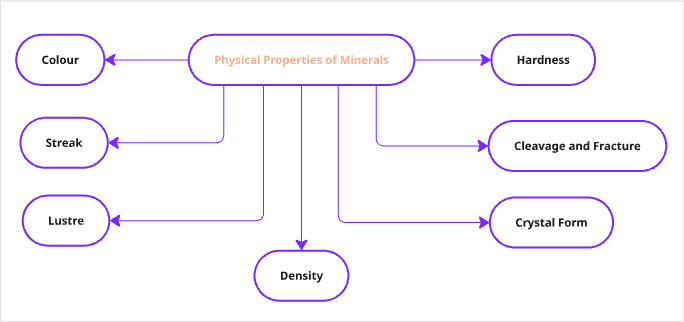
Geologists use several key physical properties to recognize minerals. Below are major properties explained with examples:
a) Colour
- The visible surface colour of a mineral.
- Not always reliable because minerals can have similar colours.
Examples:
- Sulphur: yellow.
- Malachite: green.
b) Streak
- Colour of a mineral’s powder.
- Obtained by rubbing on a streak plate.
- More dependable than surface colour.
Example:
- Hematite: grey metallic surface but reddish-brown streak.
c) Lustre
- Refers to how light reflects from a surface.
- Metallic (shiny) or non-metallic (glassy, dull, pearly).
Examples:
- Pyrite: metallic lustre.
- Quartz: glassy (vitreous) lustre.
d) Hardness
- Resistance to scratching.
- Measured on Mohs scale (1 to 10).
Examples:
- Talc: 1 (softest).
- Gypsum: 2.
- Quartz: 7.
- Diamond: 10 (hardest).
e) Cleavage and Fracture
- Cleavage: breaks along smooth, flat planes.
- Fracture: breaks irregularly, uneven.
Examples:
- Mica: cleaves into thin sheets.
- Quartz: conchoidal (shell-like) fracture.
f) Specific Gravity (Density)
- How heavy a mineral is compared to water.
Examples:
- Gold: very dense (high specific gravity).
- Pumice: very light (low specific gravity).
g) Crystal Form / Habit
- Shape that crystals grow into.
Examples:
- Halite: cubic crystals.
- Quartz: hexagonal prisms.
3. Key Characteristics of Minerals
- Natural: Found in nature, not man-made.
- Inorganic: Generally not from living things.
- Definite chemical composition: Specific chemical formula.
- Ordered internal structure: atoms arranged regularly — crystalline.
- Homogeneous: Same properties throughout.
- Non-renewable: Form over millions of years.
- Metallic or Non-metallic:
- Metallic: iron ore (hematite), copper, gold.
- Non-metallic: mica, limestone, gypsum.
4. How Do Minerals Form? (Modes of Formation)
Minerals are formed through natural physical and chemical processes that occur inside or on the surface of the Earth. Different geological processes create different types of minerals, which is why minerals are found unevenly across various regions.
Understanding these processes helps us know:
- Where minerals are located
- Why some minerals are abundant in certain places
- Why minerals are limited and need conservation
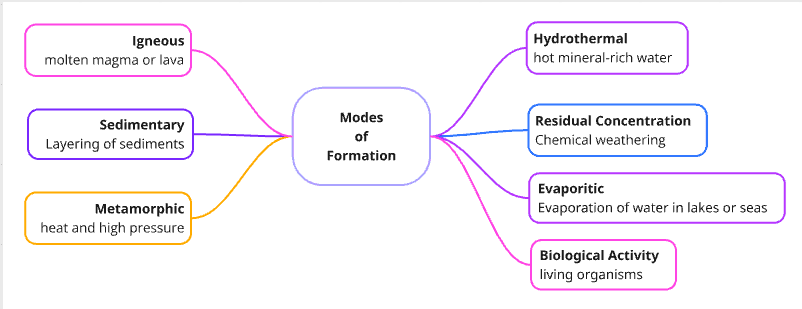
A) Igneous Processes
- Formed through the cooling and solidification of molten magma or lava inside the Earth (intrusive) or on the surface (extrusive).
- When magma cools slowly deep inside the Earth, large crystals form.
- When lava cools quickly on the surface, small crystals form.
Examples
- Magnetite and chromite — crystallize from magma
- Feldspar and mica — found in pegmatite veins (very coarse-grained igneous rock)
Key idea: Minerals form from cooling molten material.
B) Sedimentary Processes
- Formed from the accumulation, compression, and cementation of sediments over millions of years.
- Sediments include sand, silt, clay, plant remains, shells, and chemical precipitates.
- Water movement plays a major role.
Examples
- Coal — formed from compressed plant remains in swamps
- Limestone — formed from shells and skeletons of marine organisms
- Banded iron formations — iron-rich sediments layered on ocean floors
Key idea: Minerals come from layers of deposited materials.
C) Metamorphic Processes
- Formed when existing rocks undergo heat and high pressure, causing physical and chemical changes.
- Occurs deep underground during mountain building movements (tectonics).
Examples
- Talc
- Graphite
- Mica
- Garnet
Key idea: Heat + pressure transform existing rocks into new minerals.
D) Hydrothermal Processes (Aqueous Solutions)
- Occur when hot mineral-rich water moves through cracks or fractures in rocks.
- When water cools, minerals crystallize and form veins or lodes.
Examples
- Gold and copper
- Lead–zinc–silver veins
Key idea: Hot fluids deposit minerals in cracks of rocks.
E) Residual Concentration (Weathering)
- Chemical weathering removes soluble materials, leaving insoluble minerals behind.
- Over time, concentration of valuable minerals increases.
Examples
- Bauxite (aluminium ore) — from intense weathering of rocks in tropical regions
- Lateritic iron deposits
Key idea: Weathering removes impurities and enriches deposits.
F) Evaporitic Processes
- Formed when water in lakes or seas evaporates, leaving dissolved salts behind.
- Typically found in arid (dry) regions or inland basins.
Examples
- Rock salt (halite)
- Gypsum
Key idea: Evaporation of water forms salt minerals.
G) Biological Activity (Biogenic)
- Minerals formed with the help of living organisms such as marine animals, algae, or bacteria.
- Organisms extract elements from water to build shells or skeletons.
Examples
- Phosphorite
- Some limestones formed from coral reefs and shells
Key idea: Organisms contribute to mineral formation.
Conclusion
Minerals form through many natural processes such as:
- Cooling of magma
- Layering of sediments
- Heat and pressure
- Hot mineral-rich fluids
- Weathering
- Evaporation
- Biological activity
5. Distribution of Important Minerals in India
| Mineral / Resource | Major Regions / States |
|---|---|
| Coal | Damodar Valley (Jharkhand, West Bengal), Godavari Valley (Telangana), Mahanadi Valley (Odisha), Son Valley |
| Iron Ore (Hematite, Magnetite) | Singhbhum (Jharkhand), Keonjhar (Odisha), Bellary-Hospet (Karnataka), Bailadila (Chhattisgarh) |
| Bauxite (Aluminium Ore) | Odisha (Koraput), Gujarat (Kutch), Maharashtra, Jharkhand |
| Manganese | Balaghat (Madhya Pradesh), Keonjhar (Odisha), Nagpur (Maharashtra) |
| Copper | Singhbhum (Jharkhand), Khetri (Rajasthan), Malanjkhand (Madhya Pradesh) |
| Lead and Zinc | Zawar (Rajasthan), Gujarat, Maharashtra |
| Chromite | Sukinda Valley (Odisha), parts of Karnataka |
| Mica | Jharkhand–Bihar belt, Rajasthan |
| Limestone | Madhya Pradesh, Rajasthan, Chhattisgarh |
| Gypsum | Rajasthan, Gujarat |
| Rock Salt / Common Salt | Rann of Kutch (Gujarat), Sambhar Lake (Rajasthan) |
| Gold | Kolar and Hutti mines (Karnataka), Jharkhand |
| Diamond | Panna (Madhya Pradesh), Golconda (Historical) |
6. Important Patterns to Remember
- Minerals are unevenly spread in India due to geology.
- Metallic minerals are mostly linked to igneous and metamorphic rocks.
- Sedimentary rocks host coal and limestone.
- Bauxite forms in tropical, rainy, lateritic soils.
- Evaporites (rock salt, gypsum) in arid regions like Rann of Kutch.
- Quick recall:
- Damodar = coal.
- Singhbhum/Keonjhar = iron.
- Bellary-Hospet = iron.
- Sukinda = chromite.
- Koraput = bauxite.
- Panna = diamond.
- Kolar/Hutti = gold.
- Zawar = lead-zinc.
7. Short Exam Tips
- Learn mineral-source states pairs.
- Link minerals with formation processes.
- Use physical properties to describe identification.
- Practice map labelling for mineral locations.
Scenario Based Questions
-
Scenario: You find a green mineral with metallic lustre during a field trip.
- Question: How would you identify this mineral?
- Answer: The green colour and metallic lustre suggest malach...