
7. Civil Disobedience Movement (1930–34)
The Civil Disobedience Movement was a major turning point in India’s fight for freedom. Let’s look at the important points, explanations, and examples.
1. Background
Key Points
- After the Non-Cooperation Movement, there was a pause in political activities.
- By the late 1920s, the demand for complete independence (Purna Swaraj) grew stronger.
Explanation
- The Non-Cooperation Movement ended in 1922, leading to a temporary lull in anti-British protests and campaigns.
- During this quiet period, Indian leaders debated the next steps. Frustration and the desire for full independence from British rule increased.
Examples
- Many leaders began to meet and plan future strategies for India's freedom.
- Youth and new leaders, inspired by world events and the failure of reforms, demanded stronger actions for independence.
- The gap between the promise of reforms by the British and their slow delivery fuelled the urge for decisive action.
2. Simon Commission Boycott (1928)
Key Points
- The British set up the Simon Commission with no Indian members.
- Indians saw this as an insult and protested with the slogan “Simon Go Back!”
- During a protest in Lahore, Lala Lajpat Rai was critically injured by police, and later died.
Explanation
- The Simon Commission was established to recommend reforms, but the total exclusion of Indians angered people across the country.
- Peaceful protests and strikes erupted everywhere.
- The British responded with violent lathi charges (baton charges), leading to casualties.
Examples
- In Bombay, students organized processions against the Commission.
- In Delhi and Madras, shops closed in protest.
- Lala Lajpat Rai’s sacrifice became a symbol of resistance; Bhagat Singh later sought revenge for his death.
3. Purna Swaraj Resolution (1929)
Key Points
- At the Congress session at Lahore, presided by Jawaharlal Nehru, the demand for “Purna Swaraj” (complete independence) was proclaimed.
- January 26, 1930, was celebrated as India’s first Independence Day.
Explanation
- Congress leaders realized that only demanding reforms from the British would not bring real change.
- They publicly declared “Purna Swaraj” as their official goal and invited all Indians to participate.
- On January 26, people took the pledge for complete independence at meetings and flag hoisting ceremonies throughout India.
Examples
- At Lahore, the Indian tricolor was unfurled by Jawaharlal Nehru.
- People read out the pledge for full independence in villages and cities.
- The tradition of celebrating January 26 was later adopted as Republic Day post-independence.
4. Salt March to Dandi (1930)
Key Points
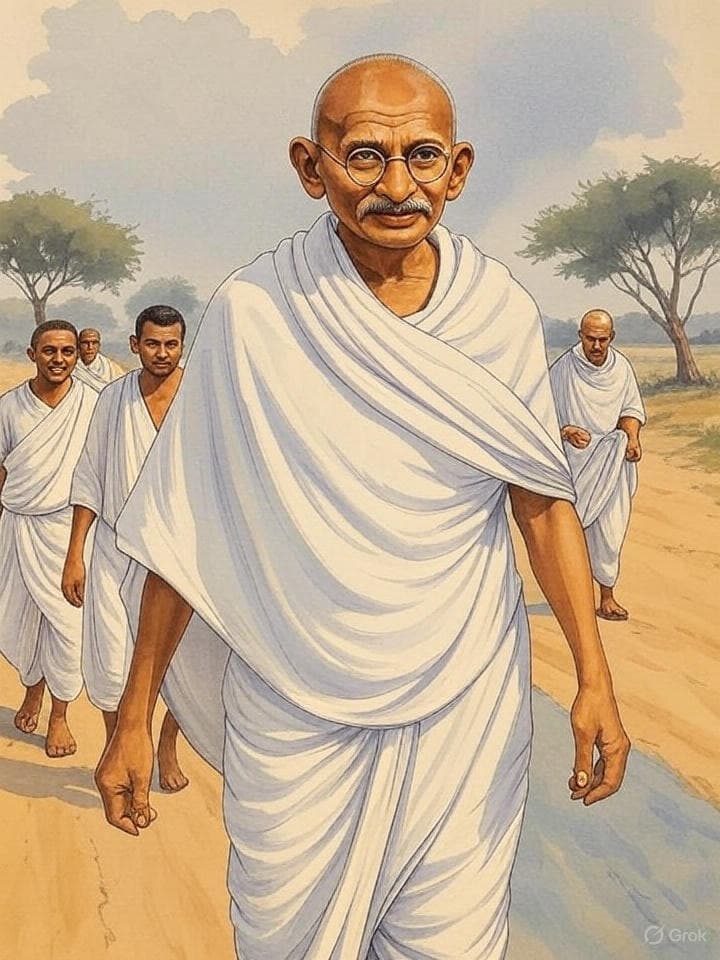
- Gandhi led a 24-day, 240-mile march from Sabarmati Ashram to Dandi in Gujarat.
- Salt was chosen because it was a basic necessity, unfairly taxed by the British.
- Thousands joined, and Gandhi broke the salt law by making salt from seawater.
Explanation
- The British salt law made it illegal for Indians to make or sell salt but allowed British monopoly and heavy taxes.
- Gandhi and his followers walked for nearly a month, gathering support in every village they passed.
- On April 6, 1930, he picked up a handful of salt, openly challenging British authority.
Activity – The Salt March
Step-by-step Instructions:
- Gather a group.
- Plan a route (pretend or real walk).
- Carry posters or chant slogans related to your goal (e.g., “Remove Unjust Laws!”).
- At the end of the march, conduct a symbolic act (hold salt or a related item).
- Record observations: see how many people joined, their feelings, and the type of support received.
Observations:
- People join when they believe in the cause.
- Simple actions, like making salt, can have a huge impact if they symbolize justice and equality.
Examples
- Women like Sarojini Naidu played key roles during the Salt March.
- In other towns, people broke salt laws by making salt at home.
- Local leaders organized similar marches in their regions.
5. Methods – Civil Disobedience
Key Points
- Refusal to obey unjust British laws (civil disobedience).
- Breaking laws such as the salt, forest, and liquor laws.
- Boycotting British goods and refusing to pay taxes.
Explanation
- Civil disobedience means peaceful non-compliance with unfair laws.
- The movement encouraged giving up foreign (British) clothes, goods, and stopping tax payments.
- Villagers stopped paying land revenue; city dwellers stopped buying imported goods.
Examples
- In rural areas, farmers refused to pay land taxes.
- In cities, bonfires were made of foreign cloth.
- Forest dwellers collected wood and salt against the law.
6. Gandhi–Irwin Pact (1931)
Key Points
- Gandhi agreed to suspend the movement.
- The British government promised to release political prisoners and permit peaceful protest.
- Gandhi attended the Second Round Table Conference in London.
Explanation
- Both sides wanted peace after many arrests and violence.
- The Gandhi–Irwin Pact was a deal: Congress would stop protests; Britain would make reforms and free most prisoners.
- However, at the London conference, demands of Indians were not fulfilled.
Examples
- Gandhi traveled to England wearing his simple attire and put India’s case before world leaders.
- Several Congress leaders, except those involved in violence, were freed from jail.
- Street demonstrations were allowed again, but with some restrictions.
7. Later Phase & End
Key Points
- The Second Round Table Conference did not meet Indian expectations.
- Protests resumed in 1932 but were brutally suppressed by the British.
- The movement gradually slowed down and ended by 1934.
Explanation
- Indians were disappointed by the failure of talks and the lack of reforms.
- Revival of agitation met strong repression—leaders were re-arrested, public meetings were banned.
- The movement faded, but the spark for freedom continued to grow.
Examples
- Many leaders, including Gandhi, were repeatedly put in jail.
- British police broke up assemblies and used force to disperse gatherings.
- The Congress once again went underground, working secretly.
8. Significance
Key Points
- Brought millions of ordinary people, including women, peasants, and tribals, into the freedom struggle.
- Spread nationalistic ideas into rural India.
- Increased the determination for complete independence.
Explanation
- The movement was not just about laws—it united people from all walks of life.
- Women, children, farmers, and workers took active roles for the first time.
- The experience built courage and confidence for future struggles.
Examples
- Kasturba Gandhi led protests when Mahatma Gandhi was arrested.
- Vegetable and salt sellers refused to pay British taxes even when threatened.
- Rural folk groups created protest songs and plays.
Scenario Based Questions
-
Scenario: Imagine you are a student in 1930 hearing about the Salt March.
- Question: How would you motivate your friends to join the march?
- Answer: I would explain that the salt march is not just about salt but about standing up against unfair laws. By joining, we show unity and our desire for freedom.
-
Scenario: You live in a rural village and see officials collecting land tax despite the movement.
- Question: What would you do to support the movement in your area?
- Answer: I would organize a peaceful boycott of tax payments along with other villagers and spread awareness about civil disobedience.
-
Scenario: Your friend asks why breaking the salt law was important.
- Question: How would you explain the choice of salt as a symbol of protest?
- Answer: Salt was essential for everyone but was taxed unfairly. By breaking this law, even poor people could join the protest and challenge the British.
-
Scenario: After hearing about Lala Lajpat Rai’s death, your classmate feels scared.
- Question: How would you help your classmate feel braver?
- Answer: I would reassure them that Lala Lajpat Rai’s sacrifice inspires us. By staying united and peaceful, we can make big changes without losing courage.
-
Scenario: You read that many women joined the movement.
- Question: How could you encourage more girls in your school to participate in today’s social causes?
- Answer: I would tell them about bold women of the past and organize events where girls can take leadership roles, showing everyone that all voices matter in creating change.