
Description of Various Sources of Finance - Part 1
1. Retained Earnings
Key Point: Retained earnings refer to a part of the company's net profits kept in the business, rather than distributed to shareholders. The business uses this money for its own needs in the future.
Elaboration:
- Businesses earn profits over time. Instead of giving away all profits as dividends, companies often save a portion.
- This saved profit is called retained earnings.
- Retained earnings are an internal source of finance.
- The business can use it for expansion, buying new equipment, or meeting unexpected needs.
Examples:
- A company earns ₹10 lakhs profit. It distributes ₹7 lakhs as dividends and retains ₹3 lakhs. This ₹3 lakhs is 'retained earnings'.
- A bakery saves part of its yearly profits. Next year, it uses this saved money to buy a new oven.
- A tech startup keeps aside some profit each year to invest in research and development.
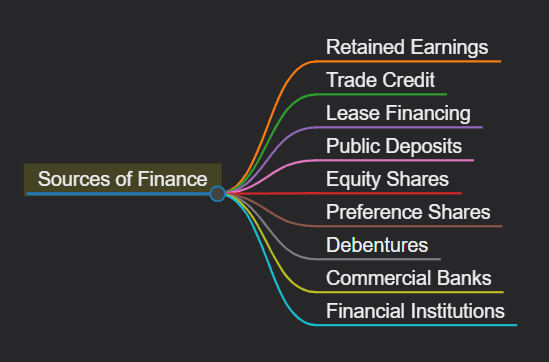
2. Trade Credit
Key Point: Trade credit is when one trader gives another trader time to pay for goods or services after the purchase.
Elaboration:
- It is a short-term source of finance.
- No immediate cash payment is required. Payment is usually due within 30, 60, or 90 days.
- Helps businesses run smoothly even if they don't have cash at hand.
- Builds trust and business relationships between buyers and sellers.
Examples:
- A garment shop buys shirts from a wholesaler and promises to pay in 60 days.
- A restaurant gets food supplies with an agreement to pay after one month.
- A stationery shop receives books from a distributor with a 45-day payment window.
3. Lease Financing
Key Point: Lease financing is an arrangement where the owner (lessor) allows another party (lessee) to use an asset in exchange for periodic payments.
Elaboration:
- Leasing avoids the need for large lump-sum payments to buy equipment.
- The lessee can use assets like machinery, vehicles, or computers by paying regular lease rentals.
- The ownership remains with the lessor, but the lessee gets to use the asset.
Examples:
- A school leases computers instead of buying them outright.
- A construction company leases heavy machinery for a project.
- A bakery leases delivery vans for daily supply operations.
4. Public Deposits
Key Point: Public deposits are funds collected by organizations directly from the public for a fixed period at an agreed interest rate.
Elaboration:
- Individuals or firms deposit money with a company, and the company promises to repay with interest.
- Public deposits are an easy way for companies to raise funds without involving banks.
- These are usually for short to medium term.
Examples:
- A manufacturing company advertises and collects deposits from the public at 8% interest.
- An NBFC (Non-Banking Financial Company) raises funds via public deposits to finance lending operations.
- A retail chain invites the public to deposit money for 2 years at a certain interest rate.
Related Concept: Commercial Paper (CP)
Key Point: Commercial Paper is an unsecured, short-term money market instrument, usually issued by companies in the form of a promissory note.
Elaboration:
- CPs are used by companies to meet their short-term financial needs.
- They do not require collateral, making them riskier for investors but easier for reputed companies to issue.
- Only companies with high credit ratings can usually issue CPs.
Examples:
- A large corporation issues Commercial Paper to raise funds for paying off suppliers.
- A finance company sells CP in the money market to manage working capital.
- An airline company issues CP to maintain smooth cash flows during the off-season.
Fun Activity: Investigating Trade Credit
Activity Objective: To understand how trade credit works in real-life situations.
Step-by-step Instructions:
- Form Groups: Divide the class into small groups of 4-5 students.
- Assign Roles: Each group selects one student to be a 'wholesaler' and others as 'retailers'.
- Scenario Based Play: The 'retailer' buys goods from the 'wholesaler' on the promise to pay after 30 days.
- Discussion: Groups discuss the advantages and risks for both wholesaler and retailer.
- Observation & Sharing: Each group shares their observations with the class.
Observations:
- Retailers get goods immediately even if they lack cash.
- Wholesalers take a risk but may build loyal customer base.
- Timely payment builds trust; delays can harm the business relationship.
Scenario Based Questions and Answers
-
Scenario: A bakery wants to buy new ovens but lacks enough cash.
- Question: Which source of finance can help the bakery and how?
- Answer: The bakery can use lease financing to obtain ovens by paying monthly rentals instead of a big lump sum.
-
Scenario: A stationery shop gets notebooks from a distributor with a 30-day payment period.
- Question: What type of finance is this and what is its benefit?
- Answer: This is trade credit. It helps the shop keep its business running without needing immediate cash.
-
Scenario: A company saves part of its annual profit for emergencies.
- Question: What is this method called and why is it useful?
- Answer: This is called retained earnings. It helps the company meet future needs without borrowing.
-
Scenario: An NBFC needs funds to lend more money but does not want to involve banks.
- Question: Which source of finance can it use?
- Answer: It can raise public deposits by accepting funds directly from the public.
-
Scenario: A reputed company wants to meet short-term financial needs quickly.
- Question: What instrument can it use and why is this preferred?
- Answer: The company can issue Commercial Paper (CP) as it is quick, short-term, and does not require collateral.