
Description of Various Sources of Finance - Part 2
Key Point 5: Equity Shares
-
Explanation:
-
Equity shares represent the ownership of a company.
-
The money raised by selling these shares is called share capital.
-
This share capital is also called ownership capital or owner’s funds.
-
People who buy equity shares are the actual owners and have the right to vote in crucial company decisions.
-
Importance:
-
Equity shareholders receive dividends, which depend on the company’s profits.
-
Equity capital is permanent and is not refunded unless the company is closed.
-
Examples:
- If a startup company needs funds, it sells equity shares to the public.
- A person buying shares of Tata Motors becomes a part-owner of the company.
- Shareholders of Reliance Industries get voting rights in shareholder meetings.
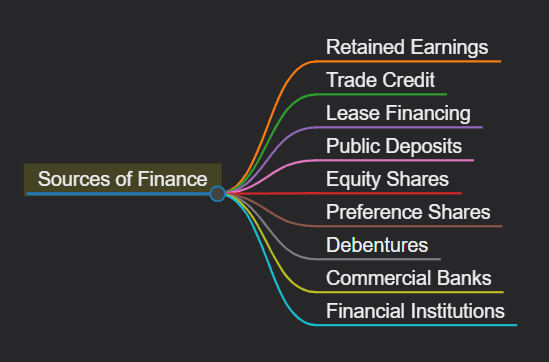
Key Point 6: Preference Shares
-
Explanation:
- Preference shares are a special type of share with preferential rights.
- The money raised from these is called preference share capital.
- Preference shareholders get a fixed rate of dividend before equity shareholders.
- At the time of winding up the company, preference shareholders get their money back before equity shareholders.
-
Importance:
- Preference shares provide a stable source of income.
- They do not generally carry voting rights on company matters.
-
Examples:
- ABC Ltd. issues preference shares with a guaranteed 8% dividend.
- If a company earns profit, preference shareholders are paid dividends before equity shareholders.
- During company liquidation, preference shareholders are paid back their capital before ordinary shareholders.
Key Point 7: Debentures
-
Explanation:
- Debentures are instruments used by a company to borrow money.
- Investors who buy debentures lend money to the company.
- Debenture holders receive a fixed rate of interest regardless of company profits.
-
Importance:
- Debentures are attractive to investors seeking regular income.
- The company must pay interest to debenture holders even if there is no profit.
-
Examples:
- A company issues ₹1 crore worth of debentures at 10% interest rate.
- A person investing in debentures of NTPC Ltd. receives regular interest payments.
- During financial crunches, companies can issue debentures to arrange quick funds.
Key Point 8: Commercial Banks
-
Explanation:
- Banks provide loans and advances to businesses of all sizes.
- Methods include cash credits, overdrafts, term loans, purchase or discounting of bills, and letters of credit.
-
Importance:
- Banks help companies to meet immediate fund requirements.
- The process of getting a bank loan is often faster than issuing shares or debentures.
-
Examples:
- A small manufacturing firm gets a cash credit facility from SBI for raw materials.
- A business uses an overdraft facility to pay suppliers when its own account balance is low.
- An export company receives a letter of credit from a bank to guarantee payment.
Key Point 9: Financial Institutions
-
Explanation:
- The government has set up financial institutions to support businesses.
- These institutions provide both owned capital and loan capital.
- They mainly focus on long-term and medium-term finance needs.
-
Importance:
- Financial institutions help in the growth of industries and infrastructure.
- They offer lower interest rates and special schemes for certain sectors.
-
Examples:
- Industrial Development Bank of India (IDBI) provides loans to new industries.
- A tech startup receives long-term finance from the Small Industries Development Bank of India (SIDBI).
- National Housing Bank gives financial assistance to real estate companies.
Scenario-Based Questions
- Scenario: You are managing a tech startup and want to retain complete control over major decisions.
- Question: Which source of finance would allow you direct ownership and voting rights?
- Answer: Raising funds through equity shares ensures ownership, allowing you to retain voting rights.
- Scenario: Your company needs to pay regular interest to investors even in loss-making years.
- Question: What source of finance should be chosen?
- Answer: Issuing debentures, as they require payment of fixed interest regardless of profits.
- Scenario: A business needs short-term funds quickly to take advantage of a sudden bulk raw material discount.
- Question: Which source of finance is most suitable?
- Answer: Commercial banks, offering facilities like cash credit or overdraft for quick, short-term funding.
- Scenario: A manufacturing unit wants funds with a guarantee of fixed dividends before any other pay-outs.
- Question: Which type of share should it issue?
- Answer: Preference shares, as they offer fixed dividends to shareholders before equity shareholders.
- Scenario: A new industry in the infrastructure sector needs long-term, affordable finance and special assistance.
- Question: Which source can provide such support?
- Answer: Financial institutions, since they are set up by the government for industry growth and offer special financial assistance.