
Merits and Limitations of Advertising
Advertising is a powerful tool used by businesses to promote their products and services. It has several advantages (merits) but also has some disadvantages (limitations). Let's explore them in detail.
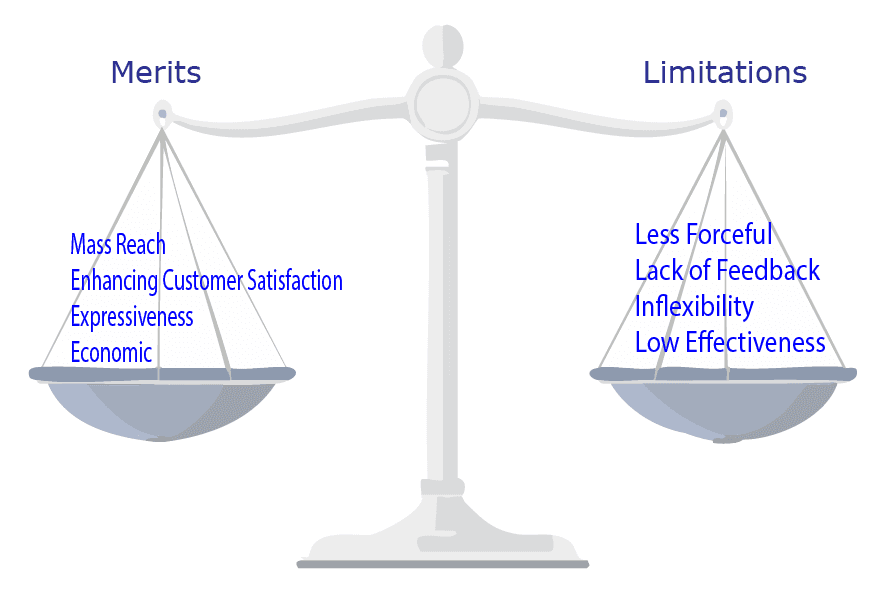
Merits of Advertising
Below are some of the metrits of Advertising
- Mass Reach
- Enhancing Customer Satisfaction and Confidence
- Expressiveness
- Economy
Let's discuss them in detail.
1. Mass Reach
Key Point: Advertising can reach a large number of people at once.
-
Elaboration:
- Through mediums like television, radio, newspapers, and now the internet, advertising messages can be broadcast to millions of people at the same time.
- This wide coverage makes advertising an effective way to inform many customers quickly.
- Government messages, public health announcements, and brand launches benefit from this large reach.
-
Examples:
- The government used advertisements in newspapers, TV, and radio to encourage people to get vaccinated against Covid-19.
- A new movie is released and its trailers are shown during popular TV shows, reaching millions of viewers.
- A mobile phone company launches a new smartphone and advertises it during the IPL cricket matches. This ensures it reaches a huge audience.
2. Enhancing Customer Satisfaction and Confidence
Key Point: Advertising builds authenticity, confidence, and satisfaction among customers.
-
Elaboration:
- When people see an advertisement for a product on major platforms, they tend to trust it more.
- Customers feel more assured about buying products that are well advertised.
- Advertising gives a sense of legitimacy. People feel that a company confident enough to advertise openly must be trustworthy.
-
Examples:
- Maggi noodles are regularly advertised on TV. This makes people confident about its quality and trust the brand.
- Customers are more willing to try a new soap that is advertised widely compared to one they have never heard of.
- Advertisements for financial services from reputed banks build trust in new customers.
3. Expressiveness
Key Point: Advertising uses creativity and technology to make products appealing.
-
Elaboration:
- Modern advertising uses graphics, music, catchy slogans, celebrity endorsements, and animation.
- These techniques help the product stand out and become more memorable.
- Advertising can tell a story, create emotions, and leave strong impressions on viewers.
-
Examples:
- A toothpaste ad that uses a popular Bollywood star and colorful visuals to show sparkling white teeth.
- Animated advertisements for children's toys using bright colors and fun jingles.
- Mobile phone ads showing stunning graphics and cool effects to camera quality.highlight
4. Economy
Key Point: Advertising distributes costs over a large audience, making it economical per person.
-
Elaboration:
- The total spending on advertising is high, but since millions see the ad, the cost per head is low.
- Compared to other methods like door-to-door selling, advertising is cheaper for reaching each customer.
- This is especially helpful when businesses want to reach a national or international audience.
-
Examples:
- A soft drink company spends ₹1 crore on a TV ad, but if 10 crore people see it, the cost per person is just ₹0.10.
- Government safety campaigns on radio cost less per listener than sending pamphlets to every household.
- A clothing brand targeting teenagers across the country finds it cheaper to do online ads than individual store promotions.
Limitations (Demerits) of Advertising
Below are Demerits or Limitations of Advertising
- Less Forceful
- Lack of Feedback
- Inflexibility
- Low Effectiveness
Let's discuss them in detail.
1. Less Forceful
Key Point: Advertising isn't very persuasive as there's no direct contact with buyers.
-
Elaboration:
- Ads are a one-way message. The seller can't adapt or answer questions during the ad.
- Many people ignore ads, skip them, or don't pay attention.
- The lack of personal connection makes advertising less effective for certain products.
-
Examples:
- TV commercials play during a cricket match, but viewers may use the break to check their phones or talk.
- A radio ad for a new insurance plan may not be trusted by listeners compared to a face-to-face explanation.
- Pop-up ads on websites are often closed or ignored instantly.
2. Lack of Feedback
Key Point: Advertisers get little or no direct response from customers.
-
Elaboration:
- After seeing an ad, the advertiser doesn’t know how people react.
- There is no instant feedback, so it’s hard to know if a message was understood or if the advertisement changed customer behavior.
- Businesses cannot easily judge the effectiveness of their advertisements.
-
Examples:
- A toothpaste company airs a new ad but is unsure if sales increased because of the ad or some other reason.
- A clothing store runs a newspaper ad but receives no replies or comments from readers.
- An online banner ad is seen by many, but the advertiser cannot tell who actually remembers the ad.
3. Inflexibility
Key Point: Advertisements use standard messages and cannot be changed easily once released.
-
Elaboration:
- Once designed and published, any mistake or need for modification requires extra cost and effort.
- The same advertisement may not be suitable for different regions or groups.
- Personalization is difficult, making it hard to target specific customers.
-
Examples:
- A newspaper ad with an incorrect phone number cannot be corrected until the next edition, causing loss of business.
- An ad made in Hindi will not be effective in a region where the majority only speak Tamil.
- A product advertised as “new” cannot change its message after a week, even if public feedback suggests changes.
4. Low Effectiveness
Key Point: Advertising can lose its effectiveness due to overload of ads and quickly changing audience interests.
-
Elaboration:
- With so many ads everywhere, it’s hard for a message to stand out.
- People become tired of ads and learn to ignore them.
- Rapidly changing trends make some ads outdated quickly.
-
Examples:
- Users on YouTube skip ads as soon as the “Skip Ad” button appears, so the ad's message is not received.
- A fashion brand's summer sale ad may not be noticed because dozens of similar ads are shown at the same time.
- Advertisements about old phone models are ignored as everyone waits for the next release.
Scenario Based Questions
-
Scenario: A company launches a new health drink and advertises it during cricket matches, reaching millions of viewers.
- Question: Which merit of advertising does this demonstrate and why?
- Answer: This demonstrates the merit of "Mass Reach." Advertising during cricket matches allows the company to quickly inform and attract a very large audience.
-
Scenario: A customer sees many advertisements for a soap brand and feels safe buying it.
- Question: What benefit of advertising does this situation ?highlight
- Answer: This shows "Enhancing Customer Satisfaction and Confidence." Repeated advertising builds trust and makes customers feel secure with their purchase.
- Question: What benefit of advertising does this situation
-
Scenario: A bakery runs a newspaper ad, but after several days, no customers mention seeing the ad.
- Question: Which limitation of advertising is illustrated here?
- Answer: This is an example of "Lack of Feedback." The bakery cannot directly know the response to its advertisement or if the ad was effective.
-
Scenario: A company launched a TV commercial but received complaints that the ad was in the wrong language for the local audience.
- Question: Which demerit of advertising does this reflect?
- Answer: This demonstrates "Inflexibility." The stereotyped, standard message cannot be quickly changed after release.
-
Scenario: Viewers often use TV breaks to do other things and miss most commercials.
- Question: Which limitation of advertising is shown in this case?
- Answer: This is an example of "Less Forceful." Without direct contact, ads are easily ignored and may not persuade viewers.